
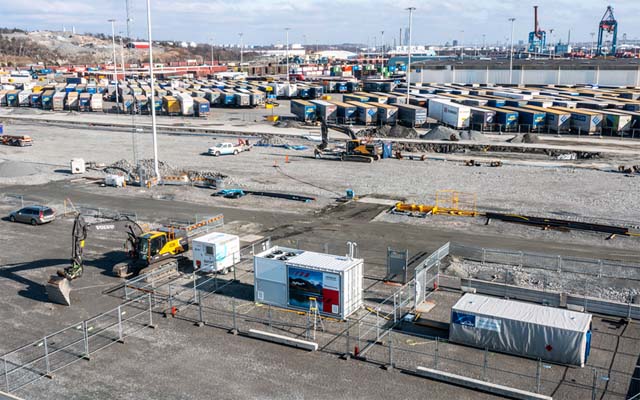
Project partners Port of Gothenburg, Skanska, PowerCell Group, Hitachi Energy, Linde Gas, Volvo Group and Skagerak Energy have conducted a joint field test to demonstrate an innovation in hydrogen-electric power infrastructure: the containerised Hyflex solution.
PowerCell Group, a global leader in hydrogen-electric solutions with unique fuel cell stacks and systems, has partnered with Hitachi Energy, a global technology leader in promoting sustainable energy, to develop a new product called Hyflex. The product is a flexible container solution that can be used in provision of shore power in ports as well as a range of other applications for emission-free power production. Hyflex uses a 100kW hydrogen fuel cell from PowerCell in combination with batteries to generate power independently of the grid without emitting greenhouse gases when using green hydrogen. The solution has been demonstrated in the Port of Gothenburg to show that it is ready to replace fossil fuel solutions in real life operations.
This trial focused on off grid power generation for construction sites and vehicles, but PowerCell considers that the technology has potential port applications, specifically with marine shore power connections (cold ironing) in mind. When docked at port, ships remain predominantly powered by auxiliary engines to provide energy while the main engines are shut down. These auxiliary engines are typically powered by polluting oil-based fuels. Therefore, the development of more, and more sustainable shore power connections is key to reducing GHG emissions in ports.
Richard Berkling, CEO of PowerCell Group, commented: “The green transition is underway, with hydrogen-electric solutions increasingly commercially valid for replacing fossil fuels in power generation – with demand for industrialised solutions supporting decarbonisation growing. At PowerCell, we see that the hydrogen industry is beyond the tech exploration stage and we are delivery emission-free fuel cell products to our customers. This makes us well-prepared and ready to be an enabler of the technology shift in the industry. The Hyflex has the potential to replace diesel generator sets across multiple platforms, as well as taking on new power generation applications. The current demonstrator has been developed with construction sites in mind, however we also recognise the need for marine and port electrification applications, such as sustainable ship-to-shore power.”
From a marine perspective, the demonstrator project supports FuelEU Maritime, under which it will be obligatory for passenger and container ships to use shore power supplies for all electricity needs while moored in major EU ports as of 2030, with a view to mitigating air pollution in ports, which are often close to densely populated areas. Sustainable shore power connections lower ships’ total GHG emissions and eliminate the local emissions of SOx, NOx and particulate matter such as black carbon produced by ships burning oil-based fuels. This improves local air quality and supports the respiratory health of nearby residents, port workers, passengers and crew.
Hydrogen and fuel cells are said to offer a strong option for shore power connections as they align well with the hydrogen infrastructure that many ports are already implementing or have planned.
Image: Hyflex demonstration in Gothenburg Port (credit: PowerCell / Blue Comms)