
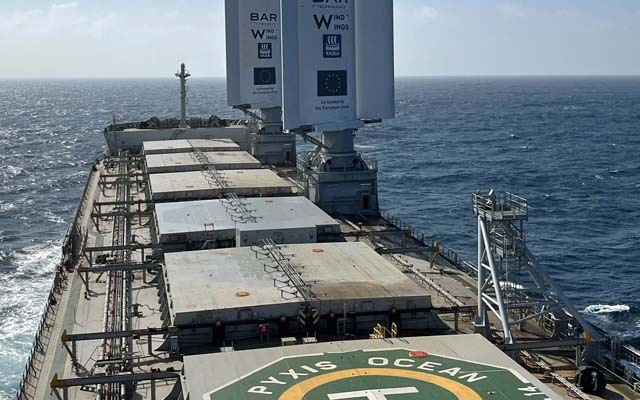
The performance of BAR Technologies’ WindWings has been validated in an interim report from DNV, which found that when sailing in favourable conditions the two WindWings installed on the ‘Pyxis Ocean’, a Kamsarmax bulk carrier under management of MC Shipping Singapore Branch and chartered by Cargill, reduced energy consumption of the main engine by 32% per nautical mile.
Pyxis Ocean is the first ship to be equipped with WindWings technology. During testing, between August 2023 and March 2024, the vessel traversed the Indian Ocean, Pacific Ocean, North and South Atlantic, and navigated Cape Horn and the Cape of Good Hope. So far, the ship has visited six ports completing eight successful loading and unloading operations.
Johanna Tranell, WAPS responsible, DNV Maritime Advisory said: “Innovative Wind Assisted Propulsion Systems (WAPS) like WindWings offer owners and operators new ways of saving energy and accelerating the decarbonisation of the maritime industry. At DNV we’re continually working to build trust in these new solutions and the best way to do that is to provide transparent, third party, verified, insights into the real-world performance of these systems. This is why we’re so pleased to be working with future focused companies like MC Shipping, Cargill, and BAR Technologies, to expand the industry knowledge base on WAPS. We look forward to building on this cooperation in the future.”
Karmesh Kumar Tiwari, Deputy Branch GM MC Shipping Singapore, said: “The confirmation from DNV that WindWings are producing significant savings is a testament to the collective work of all involved and our efforts in advancing maritime fuel efficiency. This work underpins our strong commitment to integrating low carbon technologies to contribute decarbonisation in the maritime industry.”
Chris Hughes, Decarbonisation Specialist, Cargill, said: “Validation of the performance of the Pyxis Ocean against BAR’s simulation models has been one of our main goals from the outset of this project. Having DNV involved to provide an independent perspective is an important step in that process, and this latest data builds upon the results that we shared earlier.”
According to BAR Technologies’ evaluation of the data, energy savings from all tested conditions supports the company’s initial projections: average fuel savings of 1.5t, which is a reduction of over 5t CO2 emissions ‘well-to-wake’, per WindWing per day, across all global routes and seasons. These savings, combined with the global operations of Pyxis Ocean, highlight WindWings’ effectiveness in real-world scenarios. In the future, Kamsarmax bulk carrier vessels, like the Pyxis Ocean, could carry three wings, further increasing the fuel savings and emissions reductions.
John Cooper, CEO BAR Technologies, said: “It’s been a privilege to have the performance of our WindWings thoroughly assessed by DNV, who have been rigorous in their approach to assessing the data and applying impartial standards to the results. The independent confirmation that WindWings are producing significant savings grants huge credibility to the technology. Together with our performance guarantee – offered with all WindWings – this gives our customers the reassurance they need.”
WindWings harness wind power to propel a ship forward, reducing the reliance on engines and fuel consumption. Controlled by a touch panel on the bridge, a simple traffic light system guides the crew in raising or lowering the wings. Once raised, the wings automatically adjust to the optimal configuration based on real-time wind measurements.
Image: ‘Pyxis Ocean’ with WindWings (source: BAR Technologies)