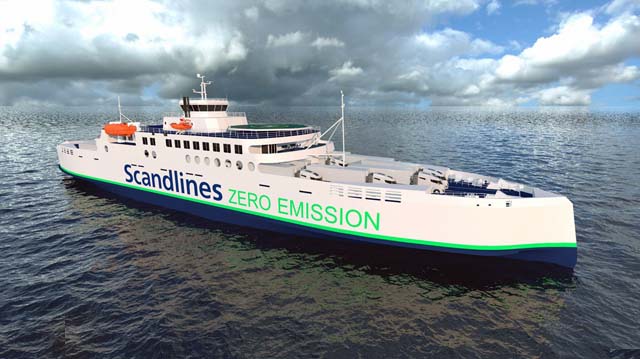
Cemre Shipyard has awarded Norwegian Electric Systems (NES) a substantial contract to supply the battery and control systems, plus act as system integrator for a zero-emission ferry that the Turkish shipyard is building for Scandlines.
NES MD Geir Larsen said: “This is the largest contract NES has ever been awarded. It will be a high-tech ferry that on completion will sail the world’s longest zero emission ferry crossing. We look forward to applying our competence and technologies to help Scandlines towards their zero emission ambitions.”
The zero-emission freight ferry is scheduled for delivery in 2024 and will operate between Puttgarden in Germany and Rødby in Denmark.
NES will act as system integrator for the ferry’s power systems and smart control set-up, involving the complete energy design, electric power and distribution including energy storage system (battery).
Jan Klokk, VP sales, NES, said: “We will manage the complete energy design. The energy storage system is currently the world’s largest for a ferry.”
Under the contract, NES will supply the battery pack, DC switchboard, generators and AC switchboards that allow two sailing modes: fully electric and hybrid electric mode (battery and biodiesel for auxiliary engines).
NES will also deliver its Raven integrated navigation system to the vessel, comprising bridge consoles, integrated alarm system (IAS) and a data collection system used to monitor vessel equipment performance. The data can be used in predictive maintenance programmes.
Larsen added: “We have committed ourselves to ensuring that maximum electrical loss is below a certain threshold, which means that we will turn every stone to make this ferry as energy-efficient as practically possible, thereby keeping operating expenditure and environmental footprint to a minimum.”
NES estimates that its total contract value will be close to NOK 100m, which is the largest contract ever for NES. It also represents a breakthrough contract in the active Turkish shipbuilding market. NES, a subsidiary of HAV Group, will involve its three Norwegian facilities – in Bergen (HQ), Egersund and Ålesund – plus its operation in Turkey to design, assemble and test the systems. NES will deliver all the equipment to Cemre Shipyard in Turkey by the end of 2023.
The new ferry will have a length of 147.4m, breadth of 25.4m and design draught of 5.3m. It will have a capacity for 66 freight units and will accommodate 140 passengers. It will be possible to transport lorries on both the upper and lower decks.
In zero-emission mode, crossing time will be one hour, with the option to operate in hybrid mode for faster speed, completing the crossing in 45 minutes. The ferry will initially recharge in Rødby, Denmark, where Scandlines has invested in a 50kV/25MW power cable to Færgevej in Rødbyhavn. This cable will now be extended to the ferry berths, where a transformer and charging station will be installed. In the longer run, the plan is to be able to charge in Puttgarden when green energy is available.
“NES’ purpose is to help shipowners and yards realise their sustainability ambitions through designing optimal propulsion, energy and control systems to ensure safety by smart and easy operation. This project encapsulates this perfectly,” said Larsen.