
Schottel, together with project funder Transport Canada and partner BC Ferries, has been investigating the emission of Underwater Radiated Noise (URN) from ship propulsion systems in the waters off Vancouver, Canada.
With international shipping increasingly exploring measures to conserve and protect underwater life, IMO is proposing the future monitoring of URN, which may lead to the establishment of thresholds combined with long-term monitoring requirements for certain regions.
The focus of the project, known as HyPNoS (Hydrodynamic Propeller Noise Monitoring System), has been on developing methods for measuring, predicting and reporting URN and deriving optimised design measures to reduce it. The research now culminates in the development of an on-board, real-time URN reporting system for crew and vessel operators.
According to Schottel, the establishment of environmental protection zones regarding URN emissions or the sighting of endangered marine life currently forces ships to avoid certain areas or to reduce their speed when passing through these areas. However, reducing speed does not always guarantee a reduction in URN. Hull vibration above the propeller is known to correlate directly with underwater noise. HyPNoS investigated the possibility of reducing underwater noise on a series of double-ended ferries in Canada, with the aim of developing a unique URN monitoring system based on state-of-the-art machine learning technology.
The immediate motivation for the HyPNoS project was the protection of whale species, specifically the Southern Resident Killer Whales in the Strait of Georgia near Vancouver. The research was carried out as part of Transport Canada’s Quiet Vessel Initiative (QVI). The research focused on developing and installing a working prototype of a calibrated live on-board URN monitoring system. This system provides live feedback to the crew and operator on the underwater noise emissions of their vessels during operation, allowing operational measures to be used to influence the emitted noise.
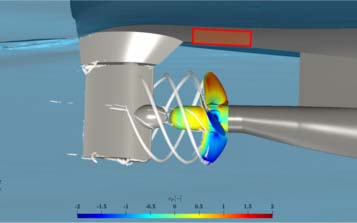
The URN measurement methods consisted of a combination of hull vibration analysis and underwater noise measurements using hydrophones. Through extensive research, a quantitative correlation between the vibrations and the emitted noise was established, resulting in a pattern from which Schottel engineers developed an algorithm for calculating and predicting URN. This algorithm can take into account factors such as propeller speed, propeller pitch, ship speed or any other input. The research was carried out on BC Ferries’ Coastal class vessels in Canada and at Schottel’s facilities in Germany. The vessels were tested with an original and a noise-optimised propeller design, which showed an average reduction in URN of 5db despite a reduced propeller diameter of 4.7m compared to 5m. This demonstrated the effectiveness of retrofitting propulsion systems to more modern designs. The researchers improved their CFD simulation tools for analysing and predicting the noise emitted into the ship and the surrounding water.
An important aim of the project was to raise noise awareness among ship operators through a real-time reporting system. In the future, such feedback systems will enable operators to react to high URN levels and take immediate action to reduce them during operation. In addition, operators will be able to perform historical and fleet-wide evaluations via an Internet cloud-based system, which could then be used to provide noise emission characteristics to authorities, organisations or the general public.
The results showed that the IMO requirements for URN monitoring systems can be met. Even minimal input, such as the measurement of vibration alone, can be sufficient to provide a meaningful assessment of the underwater noise generated. It became clear that changes in propeller design can be a sensible measure to reduce URN. In addition, the research showed that URN can be predicted to an acceptable degree at the propeller design stage and that different designs can be compared and qualified. With these new analysis and prediction capabilities, it will be possible to significantly improve propulsion systems with respect to URN, which will greatly benefit efforts to preserve marine life. The data collected by the HyPNoS project will point the way to future developments. At the customer’s request, Schottel says it is now in a position to adapt them in the product design.
Image: Simulated pressure pattern on the hull above the propeller providing a direct link to the vibration pattern and the URN emissions (source: Schottel)