
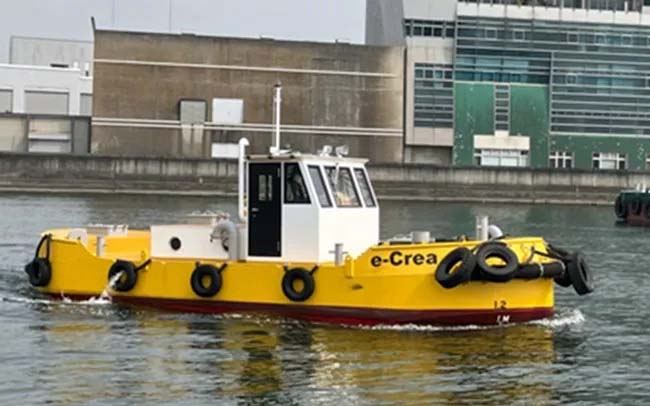
NYK has unveiled what is believed to be Japan’s first fully battery-driven work vessel, which the company has named ‘e-Crea’ (pronounced “éclair” for its visual resemblance to the French pastry).
NYK Group company Keihin Dock built the vessel at its Koyasu Shipyard. Designed without an onboard diesel generator, e-Crea will support docking and undocking at the Koyasu Shipyard. Leveraging the knowledge gained through its construction, the NYK Group says it is committed to advancing the social implementation of new technologies to realise low- and zero-carbon vessel operations.
In response to the growing global demand for decarbonising maritime transportation, the NYK Group has been actively exploring next-generation fuels, including ammonia and other advanced alternatives. Fully electric work vessels represent one of the most promising options for sustainable shipping. Keihin Dock, NYK’s sole shipbuilding subsidiary, has spearheaded this initiative, driving innovative solutions and accelerating the implementation of new technologies.
Key Features of e-Crea:
- Fully electric propulsion: Powered solely by batteries charged from shore facilities at Keihin Dock’s Koyasu Shipyard, e-Crea operates without emitting CO2. Additionally, the vessel is significantly quieter compared to conventional ships running on fossil fuels, substantially reducing operational noise.
- Compact design: Measuring approximately 9m in length, e-Crea consolidates all essential equipment within its compact hull. This design enables high manoeuvrability in confined spaces, making it suited for assisting with docking operations and vessel movement at shipyards.
Following the installation of the electric propulsion system, including substantial battery modules in the hull, the vessel’s weight exceeded initial projections. To maintain proper balance, the team reconfigured equipment placement and cabling, thereby optimising internal space and ensuring safe, stable navigation.
Elevated temperatures from batteries and electric motors can increase fire risks. To effectively manage heat, the team implemented multi-layered water-cooling systems and integrated air ducts. Enhancements to the battery room included fireproofing measures and protection against hazardous gases, along with improved ventilation. These measures ensure the vessel upholds robust safety standards.
NYK expects that introducing fully electric propulsion systems to tugboats and work vessels can accelerate decarbonisation efforts not only at the vessel level but throughout maritime and port services. The NYK Group says it remains committed to advancing and refining electrification technologies, including gradual application to larger-scale vessels. Data and insights gained from e-Crea’s construction and operation will be reflected in the development of an electric-propulsion tugboat scheduled for completion in December 2026. These initiatives are considered to reaffirm NYK’s commitment to energy-saving innovations and next-generation solutions that reduce greenhouse gas emissions.
Image: ‘e-Crea’ battery-powered workboat (source: NYK Group)