
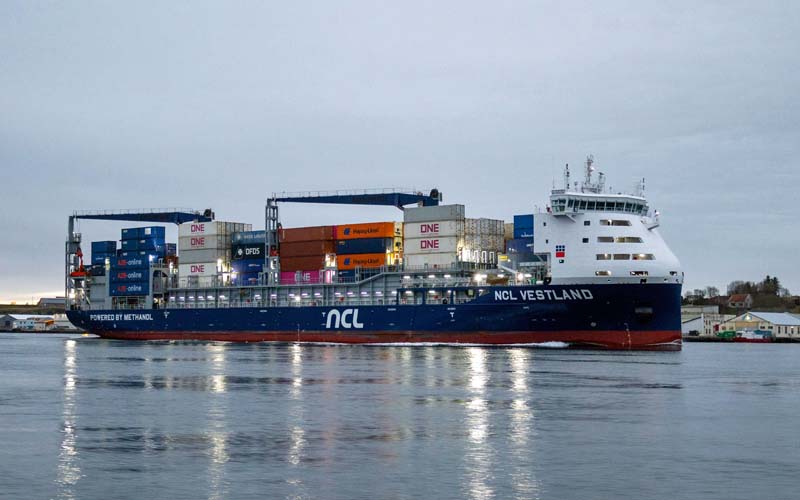
The ‘NCL Nordland’, second of two container vessels that put bio-methanol at the forefront of container shipping’s low carbon future, has entered service weeks after sistership ‘Vestland’ verified that its Berg Propulsion package optimises efficiency regardless of energy source.
Owned by MPC Container Ships, these dual fuel 1300 TEU vessels can be operated on methanol and/or MGO, under a 15-year charter to North Sea Container Line in services connecting Norway and Rotterdam.
Constantin Baack, MPCC CEO said: “Nordland and Vestland establish MPCC as an early mover in competitive green fuel strategies to deliver long-term shareholder value for shipping’s low carbon future. The project also shows how we meet ambitious goals by working with like-minded partners.”
Space efficiency and the high-performance propulsion systems built into these ships are claimed to cut energy consumption per TEU by 63% per nautical mile compared to their predecessors. NCL has signed a deal with Equinor to bunker bio-methanol – initially running on a 5% blend, but increasing bio-methanol content over time to support carbon neutral operations as the supply chain matures.
On each ship, the result is an integrated Berg energy management system and tailored total propulsion solution which consolidates the electric part of the propulsion train to optimise the two-stroke main engine performance, along with Berg’s MPP 1410 CP propeller and MTT bow and stern thrusters.
Christian Rychly, COO, MPC Container Ships, said: “Berg Propulsion and partners managed to develop, build and integrate complex systems and applied high-end technological philosophies into fully functional machinery on board both vessels despite challenges that can occur during newbuilding projects, and we would like to thank them for their cooperation and support.”
Mattias Hansson, Senior Global Sales Manager, Berg, added: “We worked as a co-designer for the integrated main propulsion solution, configuring the compact engine room layout to enable optimised aft ship design and performance. We are delighted that the teamwork between all parties in this collaborative newbuilding programme has resulted in truly exceptional ship fuel efficiency.”
Berg’s tailored solution included optimised propeller design, as well as its power and control electronics to maximise operational flexibility.
Bente Hetland, MD, NCL, said: “Nordland joins a service which is already proving itself on efficiency. This is an extraordinary example of stakeholders collaborating to overcome decarbonisation challenges cost-effectively so that green freight is the customer’s preferred choice.”
Mattias Dombrowe, Business Manager Electric System Integration, Berg, concluded: “This is next level energy management which mixes and matches the energy sources to the best advantage of ship performance. The hybridised set up optimises energy use from gensets, the shaft alternator, and 250 kWh battery for load balancing during thruster or other peak loads, also accommodating the shore connector for zero emissions when the vessels are in port.”
Image: ‘NCL Vestland’ (source: Berg Propulsion)