
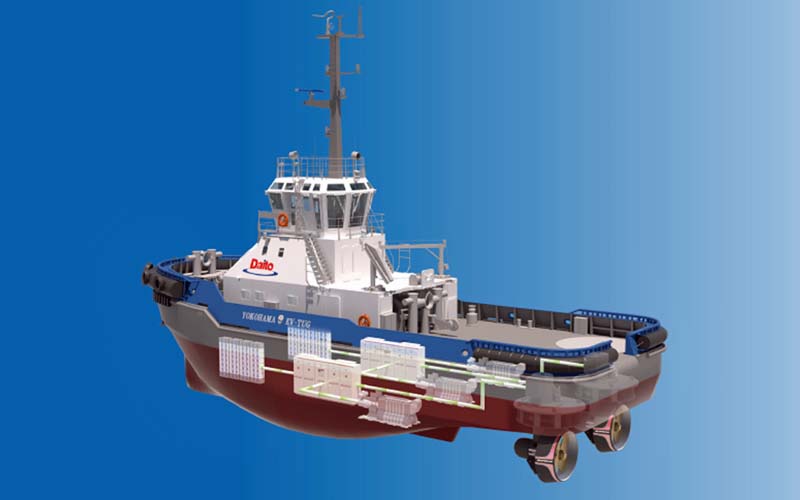
Danfoss Drives says it is driving the building of a battery-electric tugboat and a the associated shore supply system, taking another step towards meeting the 2050 IMO standard.
Tugboats are considered an attractive application for electrification; with their light load and propulsion power bringing a lot of traction power, compared to the size of the vessel. Running on battery as the main power source is seen as ideal for an inner harbour working tug as it travels short distances for idling and can be easily charged. A tugboat which is fully electric-powered produces zero emissions, requires no fuel, and operates noiselessly. This results in a significant reduction in fuel consumption, compared to a diesel-powered tug.
Around the world, the trend towards zero-emission ports is growing. Danfoss cites the example of the Port of Los Angeles. The port has been awarded an unprecedented US$ 412m grant from the US EPA Clean Ports Program to support the zero-emission transition at the nation’s busiest trade gateway. It is clear that the technologies are available, and the investments are often driven by government directions.
Danfoss says it has the technology to accelerate the zero-emission transition. In Japan, the mission for Daito Corporation, a subsidiary of Kawasaki Kisen Kaisha (‘K’ Line) to build a new tug was clear: to improve operating efficiency, reduce emissions, tackle the fuel challenges of tomorrow and meet the 2050 IMO standards as ‘K’ Line group. ‘K’ Line is a Japanese shipping company that offers international maritime transport and logistics services. Established in 1919, it operates various type of ships such as bulk carriers, car carriers, and LNG carriers, across a global network. The company is committed to environmental sustainability, striving for net-zero emission in 2050.
In November 2024, Daito Corporation announced its electric tugboat project, to be powered by a large-capacity lithium-ion battery. Delivery is expected in April 2027, and Danfoss is playing a pivotal role in the project.
The electric tug features two 1.46MW high-efficiency permanent magnet motors, two 1.58MWh battery banks as the main source of electric power, and Danfoss heat exchangers. The tug will support net-zero GHG emission goals without compromising performance. It is designed for heavy-duty and high-power operations, enabling strong peak-power performance during towing or bollard pulling and minimal energy consumption in other operating modes.
Danfoss active front-end (AFE) drives are used to supply energy from the energy storage system. The AC grid switchboard is said to enable an efficient shore energy supply, while DC grid is important for efficient energy transfer between batteries, propulsion system, and other consumers on the tugboat. Thanks to the fully electric propulsion system from Danfoss Drives, the two systems can be connected and are designed with built-in redundancy for enhanced reliability of operations. In addition, the shore supply solution allows the electric tugboats to charge while waiting in the harbour.
Image: Daito Corporation electric tug (credit: ‘K’ Line)