
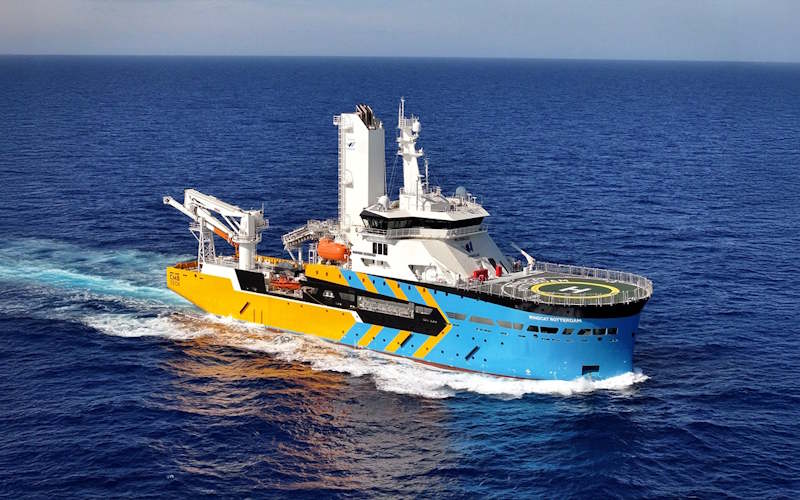
Damen’s Ha Long shipyard in Vietnam has delivered the ‘Windcat Rotterdam’, first of six vessels in the CSOV Elevation Series, collaboratively developed by Damen Shipyards Group, Windcat and CMB.Tech.
The vessel is designed to offer new standards in comfort, performance and decarbonisation. The delivery is considered a major milestone in the expansion of Windcat’s offshore service capabilities.
Windcat Rotterdam is a CSOV (commissioning service operation vessel), to support construction, commissioning and maintenance activities at offshore energy projects. It serves as a floating base for personnel and equipment, enabling safe and efficient access to offshore assets. Comfort on board is a key feature, with single and double cabins for up to 120 people, fully equipped for offshore personnel.
Willem van der Wel, MD Windcat, said: “We are very proud and happy to have taken delivery of our first CSOV, Windcat Rotterdam. It has been great to see this ground-breaking design come to life. Now that Windcat Rotterdam has been added to our fleet, we are able to offer not only best-in-class CTV services but also best-in-class CSOV services. We see a bright future for our vessels in the offshore energy industry supporting clients globally to safely and comfortably accommodate and transfer personnel to their projects offshore. Thanks to the excellent cooperation with Damen Shipyards and all key suppliers we can deliver such an innovative vessel and we look forward to the delivery of the remaining five CSOVs in the coming years.”
Joost van der Weiden, Sales Manager, Damen, added: “On behalf of Damen, I am very pleased to witness this major milestone in the development of the Elevation Series. The vessels are a clear demonstration of what can be achieved for maritime sustainability when we combine our strengths with likeminded partners and work towards a common goal. I’m looking forward to continuing our collaboration during the construction of the remaining vessels in the series.”
Windcat Rotterdam is equipped with the latest available technologies in terms of fuel efficiency and emission control such as closed bus switchboard configuration and a hybrid battery-electric propulsion system. Four azimuth thrusters enable precise manoeuvrability and efficient operations. Collectively, these techniques are expected to ensure that the vessel will already reduce CO2 emissions by 30%.
In line with the sustainability ambitions of both Windcat and Damen, the vessel is designed to operate with a significantly reduced CO2 footprint. Windcat builds on the operational experience it has with its hydrogen-powered CTVs (Crew Transfer Vessels). CMB.Tech’s hydrogen technology will be implemented in the Elevation Series CSOVs. A dual fuel hydrogen engine will enable the auxiliary genset to run on hydrogen. The hydrogen genset, storage and fuel supply system are ready for integration on the vessel once final approvals are in place. This approach supports future regulations for hydrogen use in medium-sized vessels.
Designed for offshore deployment of up to 30 days, the vessel offers high operability and safety. The 3D motion-compensated gangway offers a high vertical range and a novel 10t 3D motion-compensated crane enables heavier platform lifts in rough sea conditions in a safe and easy manner, reducing standby time due to weather changes.
Windcat Rotterdam is 99.39m long, and has three ABC main engines, one 2,390kW 12DZC and two 1,672kW 8DZC. The auxiliary genset is a MAN LE 337 dual fuel hydrogen engine (800 kW). A Corvus 1,700kW battery completes the hybrid installation, which drives four Schottel SRP430 1800 kW azimuth thrusters, two aft and two forward.
Image: ‘Windcat Rotterdam’ (source: Damen Shipyards Group)