
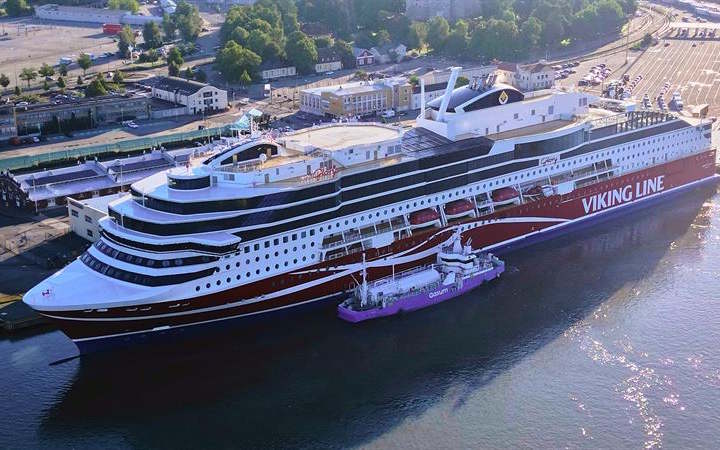
Nordic ferry operator Viking Line, which works in collaboration with energy company Gasum to develop the market for biofuel, will be increasing its purchases of renewable biofuel (bio-LNG) sixfold, which means purchasing European biogas equivalent to ‘Viking Glory’s’ total fuel consumption.
The biofuel will be consumed on the Turku–Stockholm route by Viking Glory and Viking Grace. Liquefied natural gas (LNG) will also be used as a complement. These fuels generate virtually no sulphur or particulate matter emissions, which are harmful to human health. Using biogas contributes to a circular economy since the raw materials consist of waste streams from food and agricultural waste.
Jacob Granqvist, VP Maritime, Gasum, said: “By running on biogas, Viking Line contributes to emission reductions in Gasum’s pooling service for FuelEU Maritime compliance, which is used by vessels that cannot use biofuel themselves. Viking Line thus helps the entire maritime transport sector to reduce emissions. Starting on January 1, 2025, vessels must reduce their emissions by 2%, but required reductions will increase all the way to 80% by 2050. We therefore need trailblazers like Viking Line, which can pave the way for others.”
Viking Line has collaborated with Gasum for a number of years. The shipping company used 10t of biogas in 2023 and about 600t in 2024. 2025’s biogas use will increase at least sixfold to 3,800t. At the same time, Viking Line’s GHG emissions will be reduced by 17,000t.
Dani Lindberg, Head of Sustainability, Viking LIne, said: “We have worked with others to create the market for biogas. Supply has now increased to a level that enables the use of renewable fuel to a significant extent. We have now been able to agree on our purchases through to October, and our goal is to continue at the same level. Moreover, the amount of bio-LNG used will increase thanks to the fossil-free maritime journeys that our customers purchase.”
With the significant rise in the use of biofuel, Viking Line is providing fossil-free maritime transport on all routes for the first time. For an additional fee, passengers, conference guests and cargo customers can opt to make their journey completely fossil-free, which means their trip produces zero fossil emissions.
Lindberg said: “In the 2025 survey for Finnish maritime transport, carried out by EPSI Rating, 45% of respondents indicated that they will make more sustainable choices in the future when they travel. These alternatives will become a reality only through long-term development work, bold investments and good collaboration. For example, the increased use of biofuel and the resulting decrease in total emissions have been made possible thanks to the company’s €450m investment in Viking Glory and Viking Grace.”
Viking Line has been involved in developing a green maritime corridor between Turku and Stockholm as well as between Helsinki and Tallinn, creating routes that are climate-neutral. In June 2025, the company presented a concept for a 100% electric passenger car ferry on the Helsinki–Tallinn route, which could be placed in service as early as the 2030s.
Viking Line CEO Jan Hanses concluded: “We want to be among the pioneers when Finnish maritime transport shows the way to a fossil-free future for the rest of the world. Major investments in sustainable solutions require predictability in operations and good collaboration both throughout the maritime cluster and with public sector actors.”
Image: Viking Line vessel bunkering with biogas (source: Viking Line)