
Industry collective Sea-LNG has commissioned independent research and energy intelligence firm Rystad Energy to research GHG emissions from the marine LNG bunker supply chain.
The results of the study have now been published; Sea-LNG regards this work, designed to help guide IMO’s Net-Zero Framework and future fuel policy, as the most accurate and up-to-date certified data on LNG as a marine fuel.
The study’s implications for policy makers developing regulations to decarbonise shipping are:
- Regulations should incentivise participants in the LNG bunker supply chain to continue reducing GHG emissions, particularly in relation to natural gas production and liquefaction.
- Policy makers should introduce a process to regularly update Well-to-Tank (WtT) default emissions factors used in regulation, particularly those relating to methane emissions.
- This report justifies lowering the EU WtT default of 18.5 gCO2e/MJ (in FuelEU Maritime), which is considered too conservatively high.
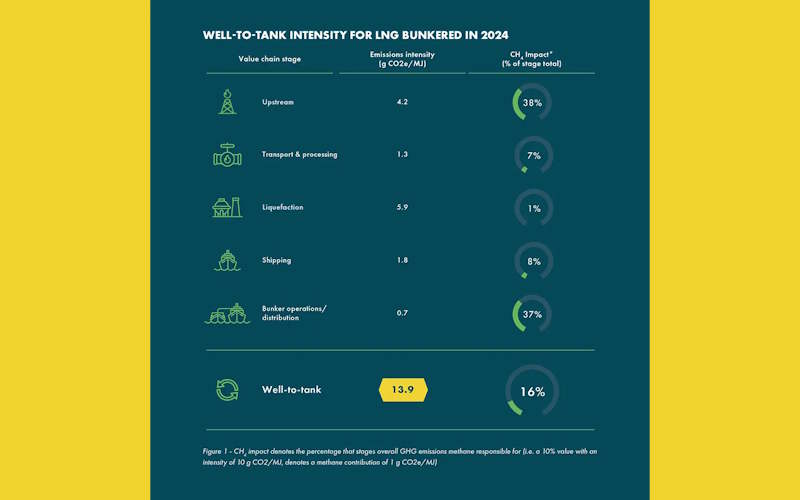
The study analyses emissions originating from the five key fuel lifecycle stages of LNG: upstream; transportation and processing; liquefaction; shipping; and distribution and bunkering operations. It aligns with the IMO WtT lifecycle analysis guidelines, the Intergovernmental Panel on Climate Change’s (IPCC) AR5 GHG definitions, and is based on asset-specific 2024 data. The study finds that 2024 global WtT emissions intensity for LNG bunkering fuel is 13.9g CO2e/MJ (LHV). CO2 dominates global WtT emissions, responsible for 84% of emissions.
CO2 emissions were most prevalent in the liquefaction stage, responsible for 99% of the stage’s 5.9 g CO2e/MJ.
Methane emissions were responsible for 16% of total WtT emissions, equivalent to 2.2 g CO2e/MJ. They were most prevalent in upstream gas production lifecycle stage, responsible for 38% of total emissions from that stage.
On a global basis, upstream gas production and liquefaction were responsible for the majority of bunker supply chain emissions at 30% and 43% respectively. Consequently, these two stages should be the focus for most future decarbonisation efforts.
Sea-LNG says that the industry should continue with its methane mitigation efforts in the upstream sector, where significant improvements have been seen over the past few years through initiatives such as the Oil and Gas Climate Initiative (OGCI) and the Oil and Gas Methane Partnership (OGMP 2.0). Improvements in liquefaction emissions have been observed over recent years, tied to greater utilisation of more efficient technologies. This trend is likely to continue when coupled with key electrification projects using renewable energy, such as hydro and solar power.
With the transition from fossil fuels in its early stages across most industry sectors, including maritime, around 95% of vessels are still powered by oil-based marine fuels. LNG is seen as the only viable option available at scale at a commercially competitive price. Consequently, it represents the leading alternative and already accounts for nearly 20% of the vessel orderbook. As the industry transitions toward net-zero and prepares for a rapidly expanding fleet of LNG-fuelled vessels, understanding the real-world lifecycle emissions of LNG is thought to be critical to shaping effective regulation and guiding future investment decisions.
Results show wide variation between regions and cargoes, reflecting differences in gas sources, liquefaction technologies, and shipping distances. In some cases, emissions intensities differed by as much as 6.6 g CO2e/MJ, highlighting that a single global average does not capture the full picture and risks leading to poorly informed regulatory choices.
Patrick King, VP Emissions Research, Rystad Energy, said: “Our analysis is based on asset-level data that ties specific gas fields to liquefaction facilities. This approach, supported by satellite-detected methane plume data and reported asset information, gives a more accurate picture of the LNG actually used for bunkering, rather than relying on outdated, hypothetical or overly broad averages.”
Peter Keller, Chairman Sea-LNG, added: “This landmark report sets the high standards the IMO should demand on such a key topic as alternative fuel emissions and performance within the Net-Zero Framework. Decisions must be based on real and recent data or risk undermining the significant progress already made along the practical and realistic LNG pathway to decarbonisation.”
Steve Esau, Sea-LNG COO, said: “Policymakers must create regulations that reflect the true carbon intensity of marine fuels, rewarding reductions across the supply chain. Marine regulators should incentivise participants in the LNG bunker supply chain to continue to reduce GHG emissions.”
The Key Findings Document can be found here, and the full Rystad Energy LNG well-to-tank emissions analysis here.