
IT and business consultancy CGI has secured funding from the UK Government through its Seeds (Sustainability Exploration and Environmental Data Science) programme for a new initiative, MaritimeTwin.
The initiative aims to cut GHG emissions from shipping by up to 15%. The project will use satellite and digital twin technology to optimise shipping routes and reduce environmental impact, supporting the UK’s Clean Maritime Plan and net-zero goals.
Led by CGI with Maritime UK, and the Industrial Decarbonisation Research and Innovation Centre (IDRIC) at Heriot-Watt University, the project will bring together expertise in digital innovation, maritime research and industry standards. It will include CGI’s DataTwin360 and EcoHub platforms. The MaritimeTwin prototype will integrate real-time satellite data with advanced digital twin technology. This will enable accurate route planning, fuel consumption optimisation, and emissions monitoring to help support decarbonisation whilst strengthening the UK’s position in clean maritime technology, driving economic growth and skilled jobs.
MaritimeTwin will provide shipping operators with a tool to simulate various scenarios, with an outcome of allowing data-driven decisions that balance operational efficiency with environmental impact. This features the incorporation of real-time environmental data, including weather patterns, ocean currents, and port conditions, and will have the ability to continuously learn and offer more precision through machine-learning algorithms.
Mattie Yeta, CGI UK Chief Sustainability Officer, said: “This award enables the development of a demonstrator that leverages real-time data to deliver tangible impact across the maritime sector. This project addresses the urgent need for maritime decarbonisation but also strengthens the UK’s position as a leader in clean maritime technology, driving economic growth and creating high-skilled jobs in the sector.”
Prof Mercedes Maroto-Valer, IDRIC Director, Heriot-Watt University, added: “The pace and complexity of pathways to decarbonisation for maritime transport demands rigorous and independent research. We are delighted to be able to leverage the expertise that IDRIC has built up over the past four years. The MaritimeTwin consortium will enable rapid development and deployment of a transformative solution for the maritime industry through close collaboration and access to real-world testing to accelerate commercialisation.”
Chris Shirling-Rooke, Maritime UK CEO, said: “Maritime UK is proud to play a role in the MaritimeTwin CMDC6 project. Our focus is on ensuring that end users and industry stakeholders are meaningfully engaged and represented throughout the project, providing forums where they can help to shape a solution that is both technically robust and market viable. By providing a clear strategy and forums for engagement, we seek to align innovation with real-world industry needs.”
Neale Ryan, Head of Land and Maritime Transport, Innovate UK, said: “The MaritimeTwin initiative shows what can be achieved when we rethink every part of maritime technology – from engine design to IT systems. CGI’s digital twin system has exciting potential to help UK and international vessels find smarter, lower-carbon routes that could make a marked reduction in shipping emissions. It is a prime example of the exciting ways that UK Shore-funded projects are setting a course for a more sustainable maritime sector.”
Seeds successfully secured funding through the Clean Maritime Demonstration Competition (CMDC) Round 6, part of a suite of interventions launched by the UK Shipping Office for Reducing Emissions (UK Shore).
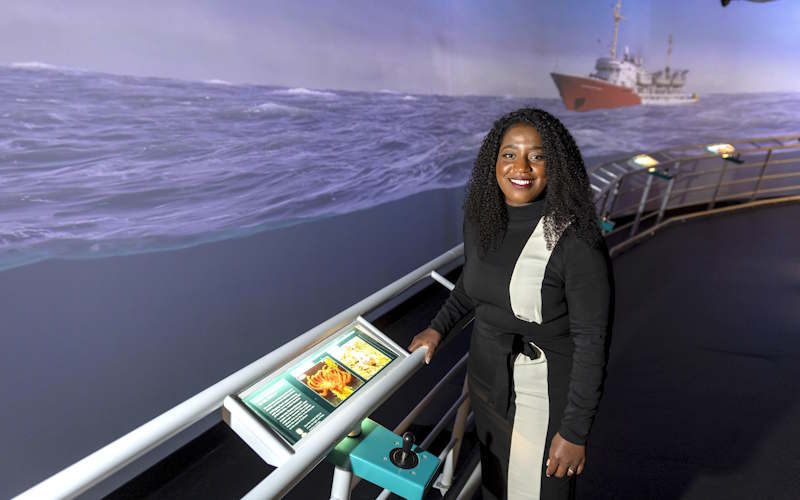
Image: Mattie Yeta, CGI UK Chief Sustainability Officer (source: CGI)