
According to Lloyd’s Register (LR), nuclear energy applications at sea, floating nuclear power plants and nuclear-powered ships can offer the maritime industry unlimited zero emission range ships, zero emission power ports and a way to produce zero-emission e-fuels.
The Nuclear Energy Maritime Organization (NEMO) aims to bridge the regulation gap between nuclear and maritime. NEMO staged a security-by-design for maritime workshop at Lloyd’s Register’s London headquarters to begin mapping this out. As demand for more efficient and less polluting shipping increases, maritime organisations are said to be increasingly looking to nuclear options to square tightening regulations with efficient operations.
The two-day NEMO event focused on bridging the regulatory gap between nuclear and maritime security-by-design framework. The workshop was the second event of the series – ‘Safeguards, Security and Safety’ – organised by NEMO and will continue in 2026. While the IMO governs international shipping, the International Atomic Energy Agency (IAEA) is focused on land-based nuclear safety, security, and non-proliferation, leaving a grey area that must be filled to allow maritime nuclear to become a reality.
Inaugural NEMO chair Dr Mamdouh el-Shanawany, former head of the IAEA Safety Assessment Section and former Nuclear Director at LR, said: “To achieve nuclear energy at sea, we need to find a way through maritime regulations under the IMO and nuclear requirements under the IAEA, and this workshop gives us an important first step to achieving this.”
The IMO’s technical officer Andrew Clarke and project officer Mara Luciano explained the IMO’s approach, with specific reference to SOLAS chapter XI-2 and ISPS code requirements, which were developed in response to the 1985 hijacking of the Achille Lauro cruise liner, and updated following the 9/11 attacks. These set clear responsibilities in the event of a maritime incident.
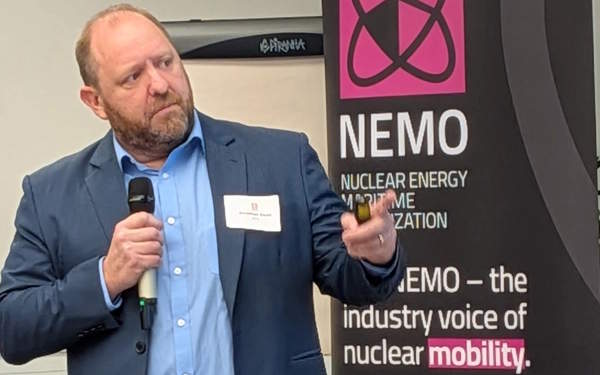
Pete Rucinski, Chief Standards Officer, International Maritime Cyber Security Organization (IMCSO) explained the growing threats to maritime organisations from cyber threats and the measures organisations need to take to meet those threats. Jonathan Dodd, Operational Security and Resilience Senior Manager, Nuclear Transport Solutions (NTS) described the threats at port. IAEA’s Head, Nuclear Security of Materials and Facilities Section, Heather Looney and Robert Officer, Head of Nuclear Security Unit ran through the international regulations and requirements for nuclear security and in particular the principle of nuclear security by design.
There are existing areas of overlap between maritime and nuclear security, and sea captain Simon Chaplain from the World Nuclear Transport Institute (WNTI) offered a model from existing Nuclear Transport Systems (NTS) voyages.
NTS uses specially designed ships to transport a range of nuclear materials up to and including the highest classification Category 1 over long distances. While much can be learned from their extremely stringent and robust security measures used by NTS, delegates agreed these were unlikely to apply to nuclear propelled ships of the future which were more likely to fall into a lesser category of material in their fuel inventories.
Finally, the event featured a group exercise to examine the voyage of a hypothetical nuclear LNG carrier, and what measures would be taken over a series of imaginary security threats of increasing severity. What emerged is that many of the measures that would be taken in response to threats against a nuclear ship do not differ significantly from those that would be taken against any conventional ship threatened in the high seas today.
Mark Tipping, LR Global Power to X Director, said: ‘The regulatory underpinnings of maritime nuclear are essential to get right because they will allow maritime vessels to operate globally to maximise zero emission benefits. NEMO is best placed to navigate a route through global regulations and enable maritime nuclear deployments now that 4th generation small modular reactors (SMRs), which have so many safety by design features built in, are a reality’.”
The security measures introduced since 1985 have evolved to be relevant for today’s maritime challenges, and can further evolve to meet tomorrow’s, and that route will be plotted in more detail in further exercises and outputs from NEMO.
Image: Jonathan Dodd, NTS Operational Security and Resilience Senior Manager, speaking at the NEMO event (source: Lloyd’s Register)