
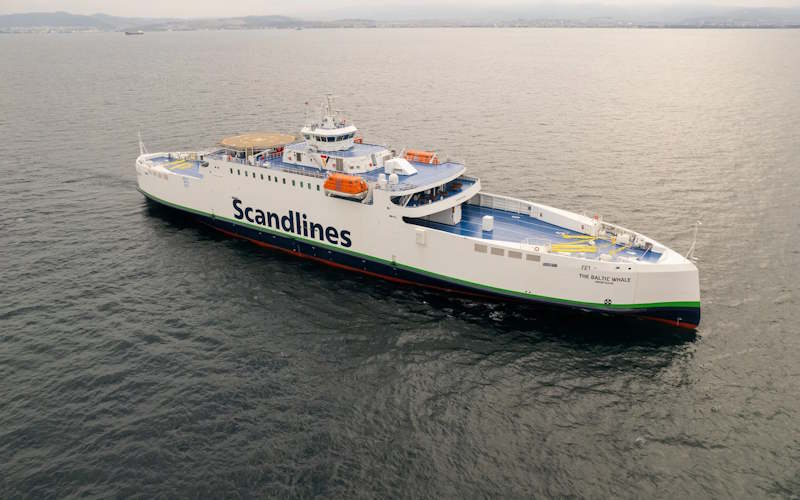
HAV Group company Norwegian Electric Systems has supplied the integrated energy and control system for Scandlines’ fully electric freight vessel, the ‘Baltic Whale’ which has now been completed by Cemre Shipyard in Turkey.
Built for operation between Rødby and Puttgarden across the Fehmarnbelt, the Baltic Whale is said by NES to represent a new era for sustainable freight transport in Europe, with the most significant integrated energy and control system project in NES history.
The Baltic Whale carries a 10.1MWh battery system – the largest ever installed on a fully electric ferry in operation. In Rødby, a 15 MW shore charging system awaits, currently the highest operational power transfer for a vessel worldwide. Together, these systems will enable a fully electric one-hour crossing with zero direct emissions.
The NES teams in Norway and Turkey worked closely with Cemre Shipyard and Scandlines to design and deliver the vessel’s complete energy and control system. At the heart of the ship’s power architecture is Quadro Master, NES’s DC-based distribution system that ties together batteries, generators, propulsion drives and onboard loads through a common DC bus. The result is considered a robust and highly efficient electrical infrastructure designed for reliability, flexibility and safety.
On the bridge, Raven INS integrates navigation, situational awareness and decision support tools into a single interface. By combining key navigation data on one platform, Raven INS supports captains and navigation officers with a clearer overview, greater precision and enhanced operational control.
The NES delivery includes the battery pack, Quadro Master DC switchboard system, Raven INS, energy control and monitoring systems, AC switchboards and distribution boards, integrated alarm system (IAS), generator and hybrid setup, bridge consoles, data logging and system integration engineering.
Image: ‘Baltic Whale’ (credit: Cemre Shipyard)