
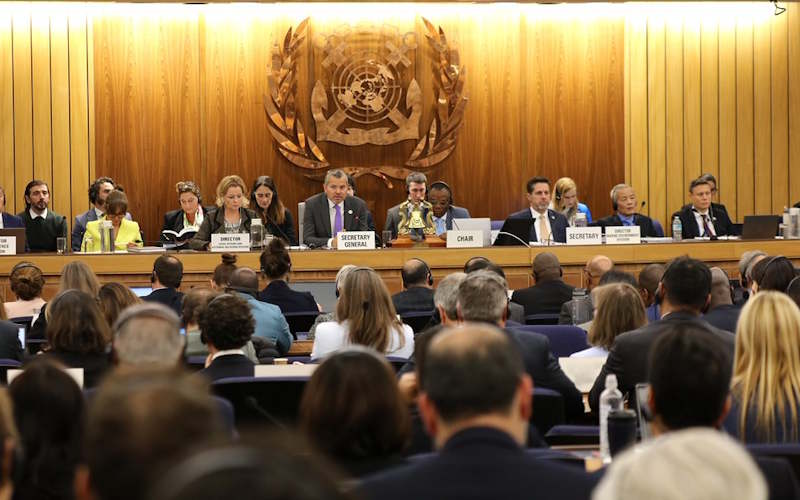
Negotiations on what was said to offer the first-ever global climate agreement for an entire industry, at an IMO MEPC extraordinary session, have resulted in failure to endorse the net aero agreement reached by MEPC in April 2025.
IMO says that the extraordinary session will be reconvened in 12 months’ time. In the interim, member states will continue to work towards consensus on the IMO Net Zero Framework.
Many IMO member states and shipping organisations have expressed their disappointment in the failure to agree on climate change. One, Danish Shipping, was quick to condemn the way that geopolitics and a new world order have made their way in to the IMO.
Danish Shipping CEO, Anne H Steffensen, said: “This is not what we came for. There have been all sorts of other agendas in the negotiation room besides climate. There wasn’t enough political will in the room to finish the job this week.”
Thomas A Kazakos, International Chamber of Shipping (ICS) Secretary General, said: “We are disappointed that member states have not been able to agree a way forward at this meeting. Industry needs clarity to be able to make the investments needed to decarbonise the maritime sector, in line with the goals set out in the IMO GHG strategy.”
Many laid the blame firmly at the feet of the US and Saudi Arabia, which both spoke out strongly in opposition to the net zero framework. The US administration had threatened to penalise nations that voted in favour of the IMO framework.
US President Donald Trump is quoted as saying: “The United States will not stand for this global green new scam tax on shipping. We will not tolerate increased prices on American consumers.”
A motion proposed by Saudi Arabia to postpone the decision and reconvene in 12 months’ time was passed by a narrow majority.
Those voting in favour of the delay included the US, China and Russia. Most of the European nations wanted the talks to continue, although Greece abstained, as did the Island states of Bahamas and Antigua and Barbuda, which rely heavily on US trade.
Sotiris Raptis, Secretary General, European Shipowners (ECSA), said: ““We regret today’s postponement of the adoption of the international climate agreement for shipping. The IMO net-zero framework is essential to give the industry the certainty it needs and to send a strong signal to the market to produce the clean fuels necessary to get to net zero. Shipping is an international industry which requires meaningful global regulations to decarbonise. Global regulation is essential to ensure a level playing field at international level and to deliver the energy transition of international shipping.”
Shipping is currently seen as being responsible for 3% of global emissions, despite carrying over 90% of global trade. Although the industry has made significant progress in reducing emissions, particularly sulphur and NOx, carbon abatement has proved more challenging. As global trade has increased, carbon emissions from ships are rising correspondingly. IMO’s own estimates suggest that without imposing global restrictions, the current emissions from shipping could grow by anything from 10% to 150%.
IMO Secretary General Arsenio Dominguez expressed a hope that the delay will not be repeated in subsequent votes. The industry in general supports the need for shipping to move towards net zero, but for this to happen, considerable investment is needed, and to achieve this there must be clarity. The postponement of the decision means that the timescales agreed by MEPC 83 for a global fuel standard and global GHG emissions pricing mechanism are increasingly unlikely to be achievable.
Image: The extraordinary session of IMO MEPC was held in October 2025 at IMO HQ (credit: IMO)