
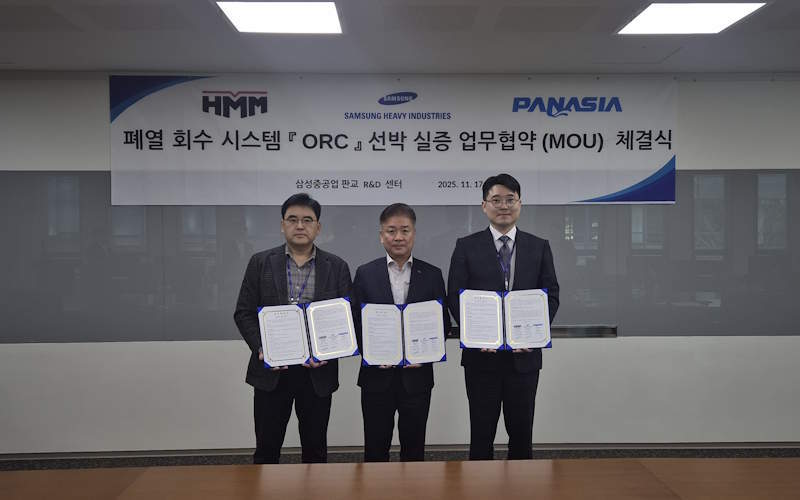
Samsung Heavy Industries (SHI) has signed an agreement with HMM and Panasia to conduct an offshore demonstration of its independently developed Organic Rankine Cycle (ORC)-based waste-heat recovery power system.
The Organic Rankine Cycle uses an organic working fluid—one that vaporises at lower temperatures than water—to convert waste heat into electricity.
SHI’s newly developed variable-pressure ORC waste-heat recovery system is an eco-friendly energy solution designed to maximise the recovery of low-to-medium temperature waste heat (70–300°C) generated on vessels and convert it into electrical power. Conventional steam-based waste-heat recovery systems used on ships rely on high-temperature heat sources (300–600°C), making it difficult to utilise the abundant low-to-medium temperature waste heat available on board.
SHI has already completed land-based testing of the system and received technology certification from ABs in May 2025.
Under the agreement, SHI, HMM, and Panasia will form a joint working group. A 250kW ORC waste-heat recovery system will be installed on an HMM-operated 16,000-TEU container vessel, with full-scale offshore demonstration scheduled to begin in the second half of 2026. As Korea’s first offshore demonstration of this kind, the three companies expect annual savings of 230t of fuel and 700t CO₂e, while validating waste-heat recovery performance, securing operational data, and assessing technical and economic feasibility.
Ho-ki Lee, Green Energy Technology Centre Director, SHI, said: “This demonstration represents a significant step toward the commercialisation of waste-heat recovery power technologies. We will continue advancing eco-friendly solutions that boost energy efficiency while reducing carbon emissions.”
Image: SHI, HMM and Panasia are to conduct sea trials of SHI’s ORC waste heat recovery system (source: Samsung Heavy Industries)