
Armada Technologies and Irish Ferries have moved into the next phase of their collaboration to assess the potential integration of Armada’s Passive Air Lubrication System (PALS) on the ro-pax ferry ‘WB Yeats’.
The current project phase is focusing on the engineering and integration design following an earlier feasibility study, with the aim of supporting the ferry operator in exploring more options to achieve its environmental objectives in reducing emissions and fuel consumption.
According to Armada, entering the market second has distinct advantages. Next-generation technology benefits from the clarity of hindsight, allowing manufacturers to navigate industry challenges and opportunities with greater precision. However, it faces the hurdle of entrenched scepticism. Previous experiences have made stakeholders more measured in their expectations, with a stronger emphasis on verified performance rather than promises. Consequently, the industry mindset has shifted from curiosity to a strict demand for proof.
Armada stresses the importance of robust, transparent performance data in building market confidence, proving technology like air lubrication can perform in a wide range of conditions and delivering measurable improvements. This was particularly true for passenger and freight operator, Irish Ferries, which is focused on reducing its environmental impact and fuel consumption. In 2023, Irish Ferries started to work with Armada Technologies in exploring how PALS could work on board the WB Yeats.
Armada’s feasibility studies are structured to ensure that, before any installation is considered, the vessel’s requirements are fully understood. This study included a CFD analysis to identify a potential design that would meet the specific needs of the vessel. Armada is now evaluating a potential installation roadmap that could be used in connection with a future dry dock retrofit, subject to the necessary commercial requirements of Irish Ferries.
The WB Yeats can accommodate up to 1,885 passengers and crew, and up to 1,220 cars or 150 freight vehicles, on its year-round service between Dublin and Cherbourg, France. In this real-world case study for next-generation air lubrication technology, Armada’s second-generation PALS system is designed to work without compressors, using the ship’s own forward motion to power the system. Mounted pods under the hull draw in air naturally using the Venturi effect and blends it with water to create a stable air-water mix.
This approach is intended to widen the potential operating window, aiming to maintain performance across varying speeds, draughts and sea conditions. By removing the need for dedicated compressors, the concept seeks to address a commonly cited concern among shipowners about first‑generation air lubrication systems, where the energy required to power compressors during voyages can offset, or in some cases outweigh, the efficiency gains.
This collaboration between Armada and Irish Ferries is thought to illustrate how ship owners and technology providers can work together to validate new solutions through staged evaluation, design and testing, rather than relying solely on theoretical performance claims. The project could potentially contribute to broader decarbonisation efforts and further demonstrate the role that innovative air lubrication technology can play in improving vessel efficiency.
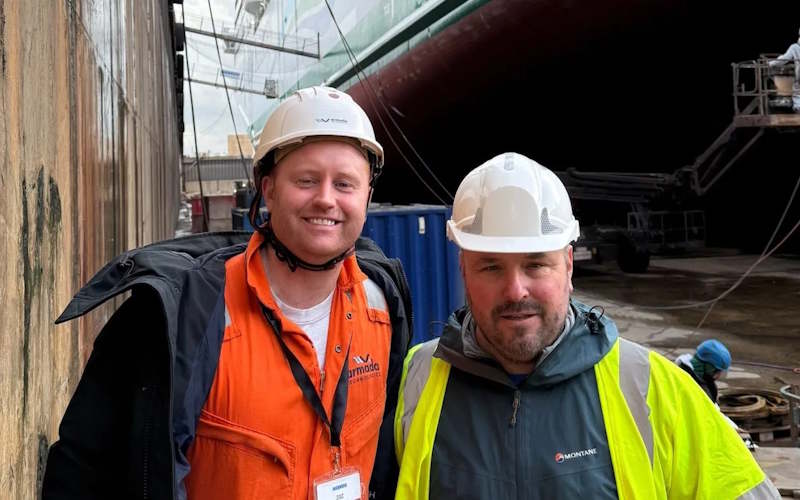
Image: Alex Routledge (Armada) and-Rob Mathieson (Irish Ferries) – (source: Armada Technologies)