
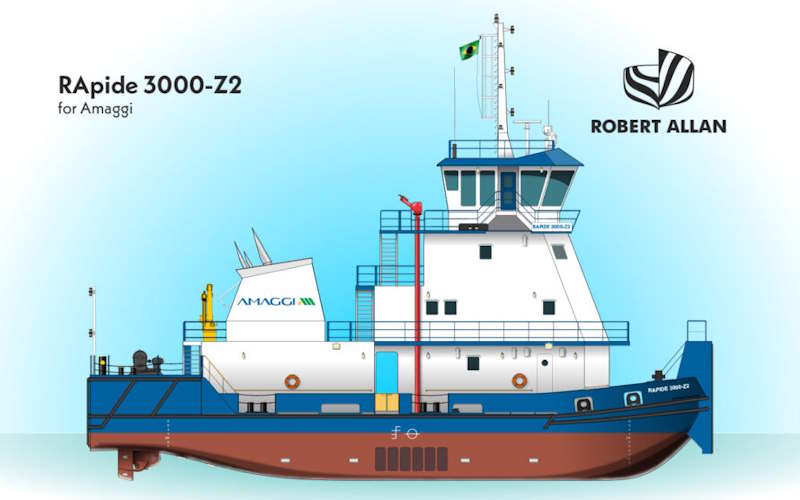
Canadian naval architect Robert Allan Ltd (RAL) has completed, for long-term client Hermasa, the RApide 3000-Z2 push boat design, described as an innovative and challenging vessel tailored to the conditions of the Madeira River system.
Hermasa has now begun construction of two of these next-generation vessels, which are expected to significantly enhance high-capacity grain transport in the Amazon region. A key differentiator of these vessels is their ability to operate on B100 biodiesel as well as conventional MDO, reinforcing Hermasa’s commitment to sustainability and reducing environmental impact.
The RApide 3000-Z2 push boats are designed for shallow-draught operation, enabling safe and efficient navigation throughout the Amazon River basin. When completed, each vessel will be capable of pushing up to 20 barges with a combined cargo capacity of 32,000t, supporting Hermasa’s commitment to sustainable, high-volume logistics.
Principal particulars are: length overall 30m, breadth, moulded: 12m, depth, moulded: 3.2m, draught, navigational: 2.3m. The vessels are designed to Brazilian Flag Rules (NORMAM-202) and will be certified as inland navigating vessels by ABS (ABS) under Class Notation ✠ A1 River Service, Towing Vessel, ✠ AMS. The vessels’ accommodations are outfitted for a crew of up to 10 personnel.
The propulsion system of the RApide 3000-Z2 push boat comprises a pair of Kongsberg US155 P14 Z-drive units, each powered by Wartsila 6L20 medium-speed marine diesel engines rated at 1150 kW. To align with Hermasa’s sustainable objectives, the engines are capable of operation with either B100 biodiesel or marine diesel oil. The Z-drives are fully withdrawable afloat and feature 1800mm FP propellers for optimal manoeuvrability and efficiency in shallow water. Electrical power is supplied by two MWM diesel generator sets, providing redundancy and reliable operation for all onboard systems.
Image: RApide 3000-Z2 design (credit: Robert Allan Ltd)