
Norwegian maritime hydrogen and ammonia network Ocean Hyway Cluster (OHC) has welcomed H2Site as a member, expanding the community that spans the full maritime and energy ecosystem.
H2Site strengthens the growing international network – especially between Norway and Spain within the maritime energy transition, and the new partnership is expected to explore new collaborative opportunities. As H2SITE joins OHC, the company steps further into a rapidly evolving maritime landscape where hydrogen and ammonia are emerging as alternative fuels for the future. With several business lines under its umbrella, H2Site is currently placing particular emphasis on the maritime sector – and especially on the development of onboard and port-side ammonia cracking technology. This technology enables ships and ports to produce high-purity hydrogen directly from ammonia, opening the door to zero-emission propulsion and auxiliary power systems.
H2Site is advancing both onboard and onshore applications, with early deployments and pilot projects already underway. These initiatives are designed to accelerate commercial-scale adoption and demonstrate how maritime hydrogen solutions can become a practical reality rather than a distant ambition.
The company sees enormous potential in the maritime industry’s accelerating push toward decarbonisation. Ammonia is gaining traction as a hydrogen carrier thanks to its high energy density and well-established global transport infrastructure.
Tomas Crespo, Maritime Business Development Manager, H2Site, said: “Norway represents a particular promising environment: a mature maritime ecosystem, strong political commitment to green innovation, and access to real-world pilot fleets create ideal conditions for early adoption. But opportunity comes with challenges. The biggest hurdle is ensuring that ammonia-to-hydrogen conversion remains both efficient and cost-competitive. H2Site is tackling this head-on with its patented integrated membrane reactor technology, capable of producing 99.97% pure hydrogen in a single step at 425°C. This approach delivers an average of 22% cost reduction compared to conventional systems – a significant advantage in a market where cost and efficiency determine scalability.”
For H2SITE, sustainability isn’t a side project – it’s at the core of the company’s mission. The technology directly supports zero-emission maritime operations, enabling clean hydrogen use without relying on fossil fuels. The company’s sustainability priorities include:
- Reducing GHG emissions from shipping
- Improving energy efficiency through single-step conversion processes
- Supporting the transition toward hydrogen and ammonia as long-term maritime fuels
- Aligning innovation with global climate goals
By focusing on these areas, H2Site aims to contribute meaningfully to a cleaner, more resilient maritime sector.
Looking ahead, H2site is preparing a new pilot project in Norway. The initiative will demonstrate continuous onboard hydrogen production for PSV vessels operating along the Western Coast. The project aims to validate a 2MW ammonia-to-hydrogen system under real maritime conditions, developed in collaboration with Norwegian shipowners and technology partners. Successful execution of this pilot is expected to mark a major milestone – not only for H2Site, but for the maritime hydrogen sector as a whole. It has the potential to position Norway as one of the first markets to adopt large-scale onboard ammonia cracking systems.
Crespo concluded: “As Norway’s leading network for the hydrogen and ammonia value chain, the [OHC] cluster brings together shipowners, technology developers, designers, and public stakeholders – all of whom align closely with H2Site’s target markets. Membership offers access to collaboration opportunities, knowledge sharing, and accelerated pilot deployment. These elements are essential for scaling hydrogen solutions and ensuring that new technologies reach vessels, real ports, and real operations.”
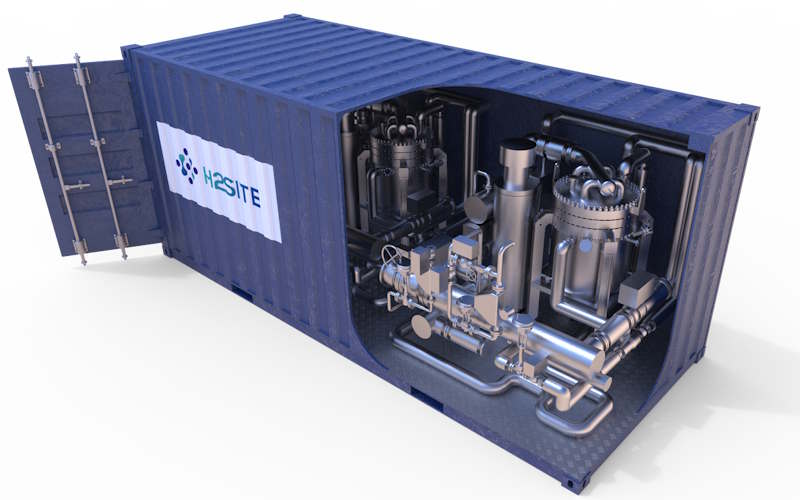
Image: H2Site containerised solution for onboard retrofit and portside applications (source: Ocean Hyway Cluster)