
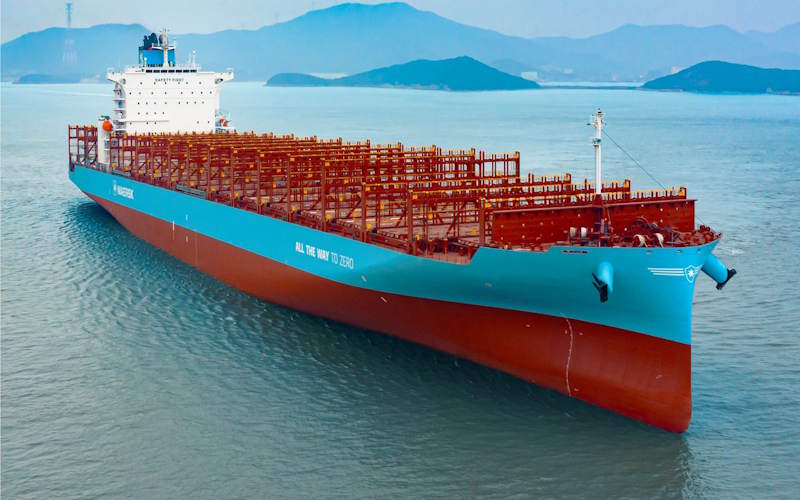
Tsuneishi Shipbuilding’s Zhoushan Shipyard (TZS) in China has delivered a methanol dual-fuelled 5,900 TEU container carrier for charter by A.P. Moller – Maersk.
The delivery is said to represent a significant milestone for the company, demonstrating that the construction of alternative-fuelled vessels aimed at reducing environmental impact has progressed beyond a Japan-centred initiative and entered a phase of continuous production at its overseas shipyard. Tsuneishi Shipbuilding has steadily expanded its track record in alternative-fuel vessels. In May 2025, the Company delivered a methanol dual-fuelled Ultramax bulk carrier from its Tsuneishi Factory in Japan. This was followed in January 2026 by the delivery of the first methanol dual-fuelled Kamsarmax bulk carrier at Tsuneishi Heavy Industries (Cebu) in the Philippines.
According to the company, the completion of the methanol dual-fuelled container vessel at TZS demonstrates that the design and construction expertise cultivated through these projects can now be deployed seamlessly across national borders. It signals that the construction of alternative-fuel vessels, including methanol-fuelled vessels, is becoming firmly established as a global production framework rather than remaining a one-off or pioneering initiative. Through these achievements, Tsuneishi Shipbuilding says it has built a foundation for the continuous construction of alternative-fuel vessels across multiple ship types and manufacturing bases.
Okumura Sachio, Representative Director, President and Executive Officer, Tsuneishi Shipbuilding, said: “The delivery of this methanol dual-fuelled container vessel at TZS marks an important milestone, demonstrating that Tsuneishi Shipbuilding has entered a phase in which alternative-fuel vessels can be built continuously at overseas manufacturing bases. Extending the design and construction expertise developed at our shipyards in Japan and the Philippines to overseas bases, including TZS in China, represents meaningful progress in our efforts to support the global transition towards lower-carbon shipping. We will continue to prioritise safety and quality while advancing the construction of alternative-fuel vessels under our global production framework, working in close coordination with our manufacturing bases in Japan and overseas.”
Image: Methanol-fuelled 5,900 TEU container ship (source: Tsuneishi Shipbuilding)