
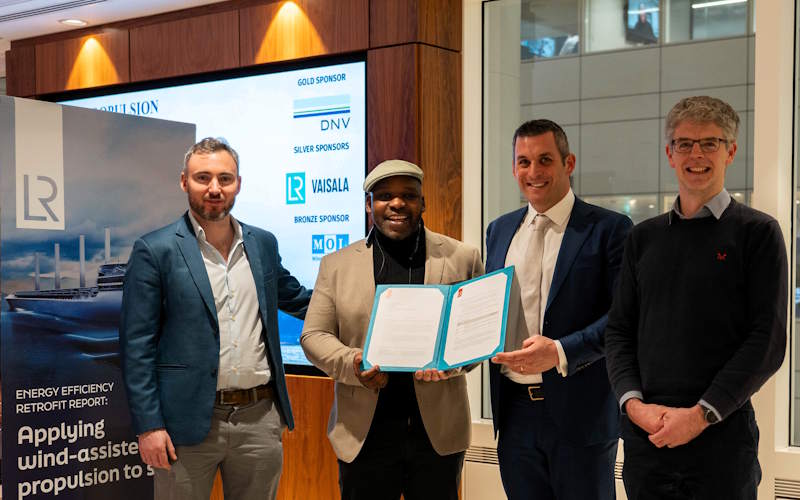
GT Wings, provider of wind-assisted propulsion systems (WAPS) to the commercial shipping industry, has secured verification from Lloyd’s Register (LR) of sea trials performance assessment methodology for its AirWing jet sail technology.
The announcement follows around 10 months of commercial operation of a 20m AirWing onboard Vectis Progress, a general cargo vessel operated by Carisbrooke Shipping. Installed in March 2025, the AirWing has been operating on live commercial routes across the Atlantic, navigating North Atlantic winter conditions, as well as on voyages through the Great Lakes and additional Caribbean sailings. The jet sail technology has demonstrated performance and reliability in a diverse range of sea and weather conditions, enabling GT Wings to seek to collect operational and environmental data to assess real-world fuel and emissions savings.
LR has verified that GT Wings’ performance assessment methodology aligns with recognised industry standards, including ISO 19030 and ITTC performance analysis practices. The review confirms that the approach used to isolate and quantify wind-assisted propulsion benefits is technically robust and suitable for in-service performance evaluation.
Andrew Hurford, LR Senior Specialist Marine, Maritime Asset and Operational Performance, said: “Independent verification of performance assessment methodologies is essential to building confidence in emerging maritime technologies. We are pleased to have reviewed GT Wings’ approach and confirm its alignment with recognised in-service performance standards.”
According to GT Wings, as WAPS moves from pilot projects to commercial deployment, transparent and defensible performance measurement is critical. Independent verification of methodology provides shipowners, charterers and financiers with confidence that projected fuel and emissions savings are assessed using recognised standards and reflect real operational conditions.
AirWing is a rigid WAPS based on proprietary jet sail technology, designed to generate high propulsive power from limited available deck space and air draught. This makes it suitable for vessels where conventional wind-assist solutions may be constrained.
Liam Campbell, GT Wings CCO, said: “We are proud to mark this milestone at RINA Wind Propulsion 2026 alongside the innovators shaping the future of maritime propulsion. From the start, our vision has been to drive the transition through measurable, data‑driven performance. Lloyd’s Register’s verification confirms our alignment with international standards and validates that our performance predictions are grounded in real‑world evidence. It is an important step toward scaling wind‑assisted propulsion across global shipping and strengthening confidence in this technology as a viable pathway to reducing carbon emissions.”
GT Wings will continue to monitor and analyse operational data from Vectis Progress as part of its ongoing validation programme. This performance analysis is based on a methodology aligned with that accepted by LR, which indicates that the resulting conclusions should be considered valid. Independent verification of the implementation is ongoing.
Robert Wester, Director, Carisbrooke Shipping said: “Reducing emissions remains a key priority for Carisbrooke and wind propulsion is a practical and effective solution for lowering carbon emissions across our fleet.”
Image: LR has verified GT Wings’ performance methodology (source: GT Wings)