
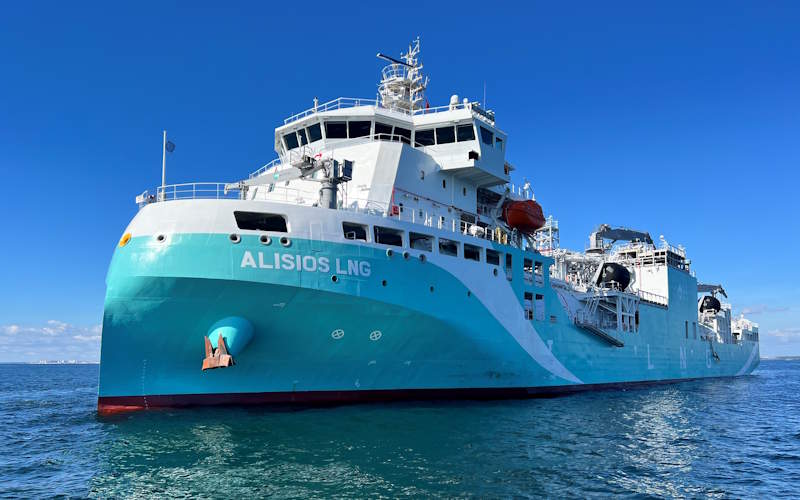
A new LNG bunkering vessel, the ‘Alisios LNG’, has been launched at the port of Huelva in southwestern Spain, for operation along the southern coast of the Iberian Peninsula, promoting the use of LNG and bio-LNG as transitional fuels for maritime transport.
Owned by Enagás through its Scale Green Energy subsidiary, the Alisios LNG has been chartered by Axpo for commercial use. Working from one of its loading terminals in Spain, the Alisios LNG incorporates advanced technology to minimise emissions during operations. Supplying both LNG and bio-LNG for maritime transport, the vessel will help further the transition towards the decarbonisation of the maritime sector.
Enagás CEO Arturo Gonzalo said: “Today’s launch is a key milestone in the development of infrastructure that contributes to the decarbonisation of the maritime sector. The adoption of more sustainable fuels, such as LNG and bio-LNG, also supports compliance with European emission reduction targets.”
Axpo Iberia MD Ignacio Soneira added: “Commissioning this new vessel further consolidates Axpo’s leadership in the small-scale LNG bunkering business as we continue our efforts to help the transition to decarbonise maritime transport.”
The Alisios LNG has a total storage capacity of 12,500 m³ of both LNG and bio-LNG, enabling it to respond to customers’ supply requirements. The vessel’s control systems offer greater manoeuvrability, allowing it to operate in a variety of different port environments. Equipped with technology designed to maintain its cargo in the best condition throughout the voyage, the Alisios LNG is designed as a versatile, efficient and reliable vessel for the supply of sustainable fuels.
Through its subsidiary Scale Green Energy, Enagás is consolidating its position as a shipowner in LNG bunkering across southern Europe, operating four vessels: Alisios LNG, Levante LNG, Mistral LNG and Haugesund Knutsen. Both LNG and bio-LNG are becoming well-positioned alternative fuels to lead Spain’s energy transition. The country’s available fleet is supported by Spain’s seven regasification plants, which have been adapted to supply LNG for bunkering. In addition, LNG terminals in Barcelona, Cartagena, Huelva and El Musel have already launched bio-LNG supply services for ships and tankers.
Committed to the transition to low-emissions maritime transport, Axpo continues to expand its bio-LNG portfolio and forge partnerships with industry leaders. The company believes such collaboration is essential to achieving global emissions targets and advancing a more sustainable future for maritime logistics. This commitment is reflected in concrete actions, such as the ten-year charter of the LNG bunkering vessel Green Pearl in Italy. The 7,500 m3 vessel transports and distributes LNG and bio-LNG, improving the speed, flexibility, and efficiency of Axpo’s small-scale LNG bunkering operations across the Mediterranean.
With new European regulations requiring a progressive reduction in maritime sector emissions, the commissioning of the Alisios LNG enables Enagás and Axpo to respond to an increased demand for alternative fuels from the industry. LNG bunkering in Spain has grown exponentially over recent years, with activity quadrupling between 2023 and 2025. Last year, LNG cargoes grew by 64% in Spain, positioning it as a strategic hub in southern Europe for the supply of alternative fuels.
As the number of bunkering vessels and supporting infrastructure continues to expand, LNG and bio-LNG are currently considered the best-placed alternative fuels to lead the maritime sector’s energy transition. Compared to traditional fuels, LNG eliminates near-100% of SOx emissions, between 80% to 90% of NOx and 25% CO2 emissions. The use of LNG as a marine fuel in Spain could reduce CO2 emissions by around 2m tonnes by 2030.