
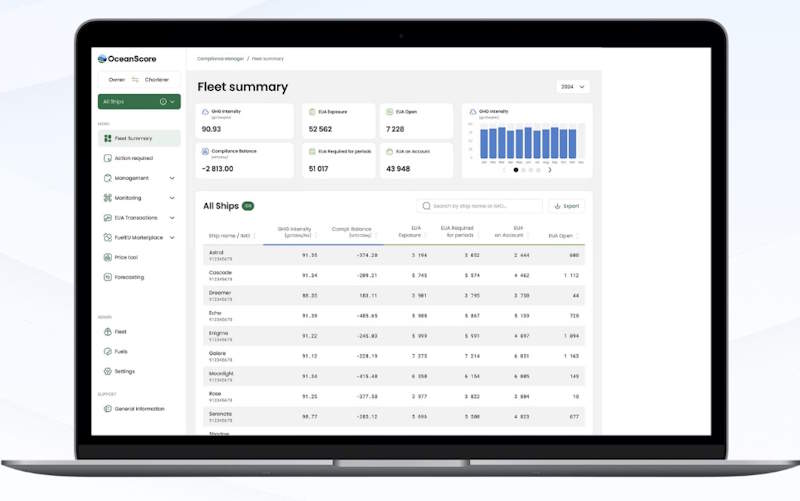
Hamburg-based maritime compliance technology company OceanScore has deployed live ERP integrations between its Compliance Manager platform and the enterprise systems of several of the world’s largest ship managers, in order to automate the exchange of operational and financial data required to manage emissions compliance under EU ETS and FuelEU Maritime between OceanScore’s Compliance Manager and the shipping companies’ financial systems, removing the need for manual data transfers between systems.
As emissions regulations require shipping companies to coordinate information across chartering, operations and finance departments, the burden of keeping compliance data current across multiple systems has grown significantly. Until now, many organisations relied on manual spreadsheet exchanges or internal staff to keep their compliance platform up to date — a process that introduces delays, errors and reconciliation overhead.
OceanScore’s integration capability addresses this directly. In one deployment, the company built an API connection into a major ship manager’s internal systems, enabling Compliance Manager to automatically read live ship lists, vessel details, charter party information and ship management agreements. This is designed to eliminate the need for clients to submit manual data updates or spreadsheets: the platform stays current automatically as commercial structures change.
In a second deployment, OceanScore built a custom API into a leading ship manager’s financial system, enabling automatic status synchronisation for EUA-related invoicing workflows. When invoice statuses change inside Compliance Manager, the financial system is updated automatically — removing a previously manual reconciliation step that consumed significant back-office time.
OceanScore MD Albrecht Grell said: “For many maritime organisations, emissions compliance has quickly become a cross-departmental workflow involving chartering, operations and finance. By enabling direct integration between Compliance Manager and clients’ internal financial systems, we allow companies to embed compliance processes into their existing operational infrastructure, not bolt them on top of it.”
Both integrations are now live. OceanScore says the capability is particularly relevant for large fleet operators and third-party ship managers handling high volumes of chartering and financial transactions, where the administrative cost of keeping compliance data current across systems is highest.
Alongside the financial system integration capability, OceanScore has expanded Compliance Manager with several automation improvements. These include enhanced off-hire calculation functionality allowing operators to capture electric consumption during off-hire periods and incorporate custom fuel types, as well as enhanced charter party logic that automatically adjusts time allocations and FuelEU compliance requests when agreements are added or modified.
OceanScore says its Compliance Manager platform currently supports more than 100 customers and over 2,500 vessels globally.
Image: OceanScore Compliance Manager (source: OceanScore)