
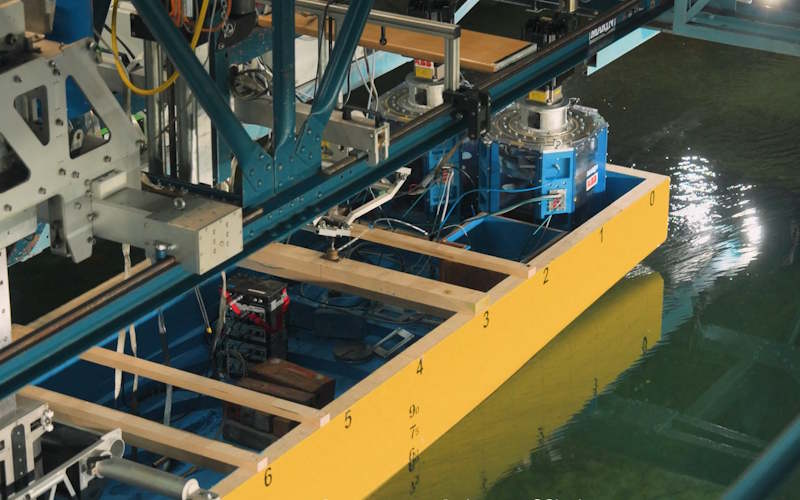
As part of a collaborative research programme, Dutch research organisation Marin has carried out model tests to compare the performance of the ABB Dynafin propulsion concept with a conventional propulsion configuration on a ro‑ro vessel.
The trials were conducted in cooperation with ABB and shipowner LD Armateurs (LDA). Using identical ro‑ro hull forms, self‑propulsion model tests were performed to enable a direct and objective comparison between ABB Dynafin and a conventional twin‑shaftline arrangement.
The validation programme combined advanced computational fluid dynamics (CFD) calculations with dedicated model tests, measurement systems and transducers to determine hydrodynamic loads and propulsive efficiency. The outcomes are consistent with results obtained in earlier Marin studies on ABB Dynafin and confirm the suitability of the applied test methodology for evaluating innovative propulsion concepts under controlled and reproducible conditions.
ABB says that Dynafin mimics the movement of a whale’s tail. It is a cycloidal propulsion system comprising a horizontal wheel rotating at 30–80 rpm and vertically descending blades. The pitch and angle of the blades are individually controlled in real time, delivering optimal hydrodynamic efficiency and instant thrust vectoring while reducing noise and turbulence.
Test results showed that at the vessel’s design speed of 17 knots in ideal trial conditions, the ABB Dynafin units required approximately 22%less delivered power than the twin-shaftline setup. All three partners suggest that the tests offer evidence that will encourage other stakeholders to set aside time for a deeper dive into the efficiency gains ABB Dynafin can bring for cargo vessels.
Marin sees untapped potential to exploit the unit’s thrust vectoring capability for use with wind-assisted ships by incorporating AI-driven, self-learning controls to boost real-time fuel optimisation, while also achieving roll damping and heeling correction and supporting better energy regeneration.
Arthur Barret, LDA Head of Engineering, Projects and Innovation, said: “Even after deducting the electric losses inherent to diesel-electric propulsion, the gain remains substantial compared to conventional twin shaftlines.”
Image: Model tests of ABB’s Dynafin system at Marin (source: Marin)