
Swiss turbocharging and digital solutions company Accelleron has highlighted how Asia Pacific ports are building early foundations for green hydrogen-based e-fuel markets through coordinated cross-sector action.
This momentum seen as being driven not only by decarbonisation, but also by a focus on long-term energy security across the region. Accelleron believes that the ships are ready, but the fuels are missing. While vessel technology has advanced rapidly and dual-fuel ships capable of running on methanol and ammonia are setting sail, fuel production remains very slow, due to fragmented demand, high upfront costs, and the scale of infrastructure required.
Christoph Rofka, President, Accelleron Medium- and Low-Speed Division, said: “Where e-fuel projects succeed, energy and multiple hard-to-abate industries move together. Combining demand creates contracts large enough to start building, shares risk so projects become insurable, and allows developers to build infrastructure once instead of duplicating it. Ports can anchor that process by planning and developing bunkering infrastructure to supply inland power generation and industrial demand first, preparing the way for future maritime uptake.”
Accelleron’s report Asia Pacific as the proving ground for overcoming shipping’s carbon-neutral fuel deadlocks shows early green hydrogen and e-fuel projects advancing across major ports, including Singapore, Yokohama, Busan, and Shanghai. These pilots are being driven by national hydrogen and e-fuel strategies linked to industrial decarbonisation and energy security objectives, rather than shipping demand alone.
Across the region, ports are advancing ammonia and methanol projects, developing safety frameworks, strengthening fuel-handling capabilities, and building operational readiness. At the same time, early hydrogen and e-fuel production is moving forward through cross-sector offtake in land-based industries such as power generation, chemicals, and heavy industry. This broader demand base allows fuel systems, infrastructure, and standards to develop ahead of anticipated larger-scale maritime uptake.
The research shows the outline of an early e-fuel market emerging in Asia Pacific, with ports taking on complementary roles based on their resource bases, industrial structures, and geographies. A supply-demand dynamic architecture for hydrogen and e-fuels is forming, with ports leveraging their strengths to serve as either producers, connectors, receivers, or export sources.
In addition, high-volume trade corridors like the Australia-Singapore-China iron ore route, are emerging as practical pathways for early fuel deployment, aligning industrial demand (iron ore conversion with hydrogen), maritime traffic, and port readiness. The research highlights the Singapore-Rotterdam route as a developing link between Asia Pacific’s emerging e-fuel system and European demand centres.
The Port of Yokohama illustrates how national policy, local government coordination, and industry collaboration are realising this public-private cross-sector approach in practice. As one of Japan’s designated carbon neutral ports (CNPs) under the programme led by the Ministry of Land, Infrastructure, Transport and Tourism, Yokohama is aligning port development with nearby industrial demand and the national energy strategy.
The Port of Yokohama’s roadmap comprises 145 public-private partnership projects covering fuel-handling systems, hydrogen, ammonia, and methanol supply chains, as well as a robust programme of port-area decarbonisation, including shore power, electrified equipment, and financing mechanisms. It is also coordinating closely with neighbouring Kawasaki City to align regional fuel supply planning and industrial energy demand.
Hitoshi Nakamura, Director for Carbon Neutral Port Promotion, Port and Harbour Bureau, City of Yokohama, said: “To achieve decarbonisation in international shipping and logistics, and in heavy industries such as power generation, steelmaking, and chemicals, Japan’s Ministry of Land, Infrastructure, Transport and Tourism has launched the carbon neutral port initiative, which aims to broadly decarbonise port areas, where all of these converge. Public support is critical to enabling early development, especially when we are working across multiple sectors. Through the Yokohama Port CNP sustainable finance framework, we have made it easier for companies to access green loans and other financing, and in a short time have launched 145 projects spanning port decarbonisation, fuel-related infrastructure, and supply chains. We see that this structured, public-private, cross-sector approach is effective in accelerating infrastructure and market development, and we are seeing very promising progress toward the goals of the CNP initiative.”
The report Accelerating to Net Zero: Asia Pacific as the proving ground for overcoming shipping’s carbon neutral fuel deadlocks can be downloaded here.
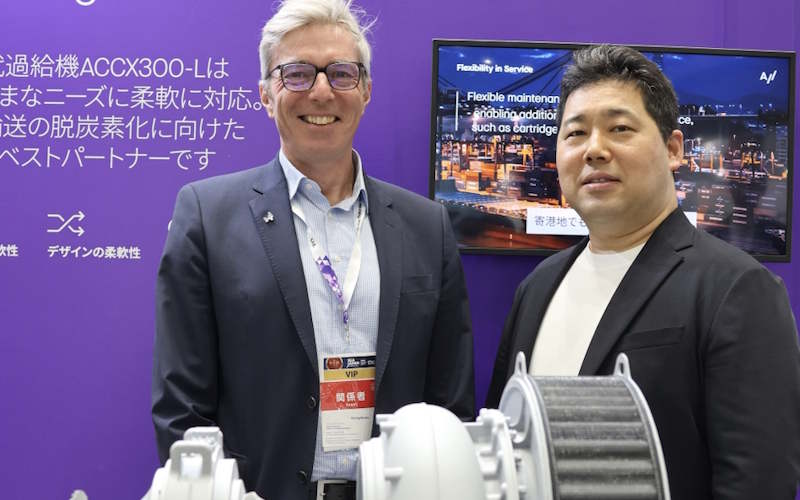
Image: Christoph Rofka, Accelleron, and Hitoshi Nakamura, Port and Harbor Bureau, City of Yokohama (source: Accelleron)