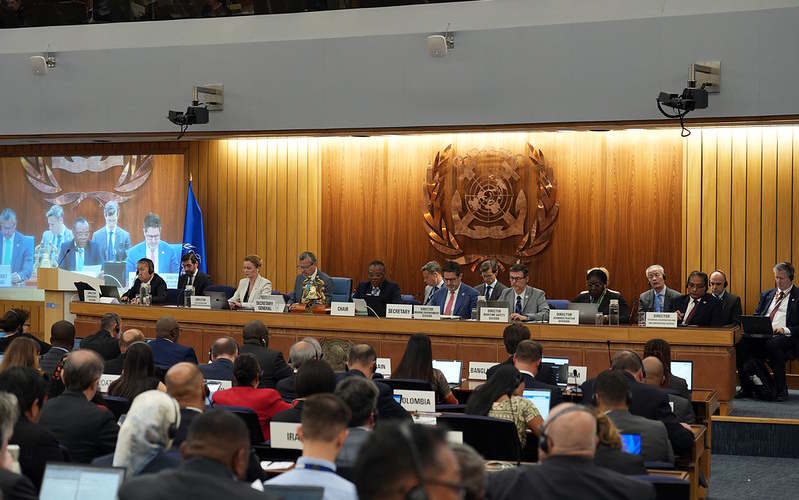
The 84th session of IMO’s Marine Environment Protection Committee (MEPC) was held at IMO headquarters in London from 27 April to 1 May 2026, chaired by Dr Harry Conway of Liberia.
Although the IMO has, practically speaking, made little progress with the net zero framework (NZF), MEPC84 nevertheless managed a consensus on various issues to do with global shipping emissions, while sounding the alarm over environmental risks in the Strait of Hormuz and adopting new measures to curb air pollution in the Northeast Atlantic.
IMO Secretary-General Arsenio Dominguez said: “We are back on track, but we have to rebuild trust. I encourage you to maintain this momentum through your intersessional work and to prepare submissions that can bring the membership together.”
The Committee will resume its second extraordinary session on Friday 4 December 2026, subject to confirmation by the 85th session (MEPC 85) scheduled to convene 30 November to 3 December.
Nearly 100 delegations took the floor to voice their views on NZF, in particular the adoption of ‘mid-term measures’ to address GHG emissions from ships – with multiple proposals tabled on how to take forward negotiations. The Committee agreed to establish an intersessional working group to resolve various concerns and drive broader convergence on a global measure ahead of MEPC 85 in six months. Member states will be able to submit new amendments and adjustments to the draft amendments previously approved. Two inter-sessional meetings will be scheduled (1 to 4 September and 23 to 27 November) ahead of MEPC 85 (30 November to 3 December), as well as a one-day expert workshop on ‘chain of custody’ models, which track fuel origin and movement of fuels across the supply chain, ensuring emissions are properly traced and verified. The second extraordinary session of MEPC (adjourned from October 2025) is scheduled to resume on 4 December 2026, subject to discussions at MEPC 85.
The Committee adopted a resolution condemning the attacks on commercial shipping in the Strait of Hormuz region and the related risks of marine pollution. MEPC84 recognised the vulnerability of the Persian Gulf and adjacent waters, warning that these attacks could cause large-scale marine pollution such as oil, hazardous and noxious substances and hazardous residues arising from missiles, drones, fires and explosions. It requested the Secretary-General to monitor environmental impacts and report to the next IMO Council session.
The Committee adopted a new Emission Control Area (ECA) in the North-East Atlantic, introducing stricter emission limits on NOx, SOx and particulate matter. Entry into force date is set for 1 September 2027, with the ECA taking effect 12 months later in 2028. The new ECA covers the exclusive economic zones and territorial seas, extending up to 200 naut mile from their baselines of Greenland, Iceland, the Faroes, Ireland, the mainlands of the United Kingdom, France, Spain and Portugal. Within ECAs, ships must use fuel with a sulphur content of no more than 0.10%.
The Committee adopted the 2026 Strategy and the action plan to address marine plastic litter from ships, reaffirming IMO’s goal of zero plastic waste discharges to sea from ships by 2030.
The Committee agreed to develop a mandatory code governing the maritime transport of plastic pellets in freight containers, under Marpol Annex III and/or the SOLAS Convention. The sub-committee on pollution prevention and response (PPR 14) was tasked with drafting the code and reporting back to MEPC.
The Committee approved a package of amendments to the ballast water management (BWM) convention, following a review of the treaty and its associated instruments under an experience-building phase (EBP). The review was conducted to refine implementation, close regulatory gaps and ensure the convention remains an effective and practical tool for protecting marine ecosystems. The Committee adopted revised guidelines for ballast water management and development of ballast water management plans (G4).
The Committee advanced its work on underwater radiated noise (URN), agreeing in principle to extend the EBP by two years, to the end of 2028. The EBP aims to address barriers member states face in applying IMO’s revised URN guidelines. The Committee agreed in principle to commission an IMO study on URN emissions, as an evidence base for possible future measures. Member states were invited to submit proposals for a URN policy roadmap to MEPC 85.
The Committee agreed on new outputs to work on over the next two years:
- Amendments to regulation 12 of Marpol Annex VI to prohibit the reintroduction of ozone-depleting substances on ships; and
- Measures to address maritime autonomous surface ships (MASS) in the instruments under the purview of the Marine Environment Protection Committee.
- A new output on ‘Supporting the implementation of the BBNJ Agreement within IMO’s regulatory framework for protecting the seas and oceans and marine biodiversity’ was agreed in principle, subject to further consideration by MEPC 85.
The Committee also took action on the following:
- Approved the Terms of Reference for the Fifth IMO GHG Study and requested the IMO Secretariat to initiate the procurement process for the study;
- Adopted 2026 Guidelines for test bed and onboard measurements of CH4 and/or N2O emissions from marine diesel engines;
- Approved draft amendments to the 2008 NOx Technical Code in relation to non-carbon containing fuels, with a view to subsequent adoption.
- Agreed that a standalone legally binding instrument should be developed for the control and management of ships’ biofouling to minimize the transfer of invasive aquatic species.
IMO intends to publish a full meeting summary in due course; meanwhile classification society Bureau Veritas has published its summary which can be downloaded here.
Image: MEPC84 (credit: IMO)