
Wind assisted propulsion system (WAPS) company GT Wings has introduced a holistic ship performance assessment tool to support early-stage evaluation of its AirWing system.
The tool, developed by independent wind assist expert Blue Wasp Marine and based on its proprietary Pelican Suite web-based platform, will enable GT Wings to develop and submit reliable and structured indications of potential fuel, emissions, and regulatory savings.
RINA’s review and verification confirm that the modelling methodology and performance assessment framework of the Pelican Suite tool are aligned with recognised industry standards and guidelines. RINA’s Approval in Principle (AiP) provides confidence that the approach is suitable for early-stage evaluation of wind-assisted propulsion solutions, offering shipowners a basis for preliminary technical and commercial assessments.
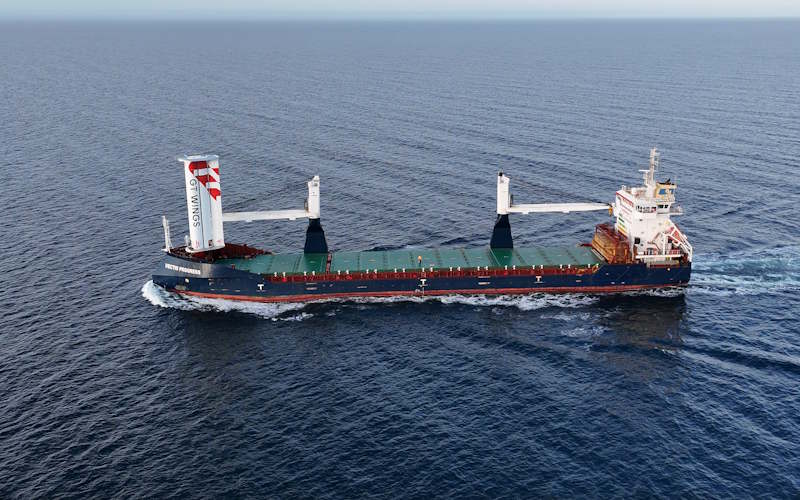
GT Wings has developed the AirWing Jet Sail WAPS using controlled suction and blowing to achieve high aerodynamic performance with a minimal deck footprint. As WAPS adoption accelerates, shipowners are said to be increasingly seeking reliable early-stage insights to inform both technical and commercial decisions. GT Wings’ Jet Sail system has already been installed onboard Carisbrooke Shipping’s Vectis Progress, with additional orders from Grieg Maritime Group, and the company has completed more than 80 early-stage performance assessments to date. This new tool builds on that experience, enabling more consistent and transparent initial evaluations.
The assessment tool enables rapid, route-based simulations to estimate potential fuel, emissions and regulatory savings across different vessel types, operating profiles, and AirWing configurations. Using a four-degrees-of-freedom (4DOF) modelling approach, the tool is designed to provide a consistent, physics-based indication of performance. This allows shipowners to compare options and build an early business case with greater confidence.
The modelling approach and outputs were verified in line with industry practices by RINA, supporting alignment with recognised standards such as MEPC circ.896 and the ITTC Guidelines for Wind Powered Ships (2024), providing an additional layer of assurance for shipowners. By combining GT Wings’ project experience with independent modelling and a clear verification pathway, the tool is considered to provide a neutral and credible view of performance potential.
Jonny Gambell, Sales and Strategy Director, GT Wings, said: “Our Jet Sail technology represents a fundamentally new approach to wind propulsion. To best serve our customers’ interests, it’s vital that early performance assessments are credible and transparent. This tool gives shipowners a trustworthy first view of potential savings, helping them to understand the return on investment and the reduced emissions that our technology brings. We are fortunate to be working with Blue Wasp, who’s unrivalled simulation expertise has helped us to develop this state-of-the-art performance tool.”
Giovanni Bordogna, CEO and R&D Lead, Blue Wasp, added: “We are proud to contribute to the development and credibility of the wind assist industry through state-of-the-art performance prediction tools. This approval from RINA for our Pelican Suite software is an important recognition of our work and confirms that we are progressing in the right direction.”
Patrizio Di Francesco, Special Projects North Europe Business Development Manager at RINA, concluded: “As a member of the International Windship Association, RINA is pleased to collaborate with GT Wings in addressing the challenges related to wind propulsion performance prediction, leveraging its newly developed Rules for wind assisted propulsion systems and granting an approval in principle to support a robust and reliable assessment framework.”
Image: GT Wings’ Jet Sail wind propulsion system installed on Carisbrooke Shipping’s ‘Vectis Progress’ (credit: GT Wings)