
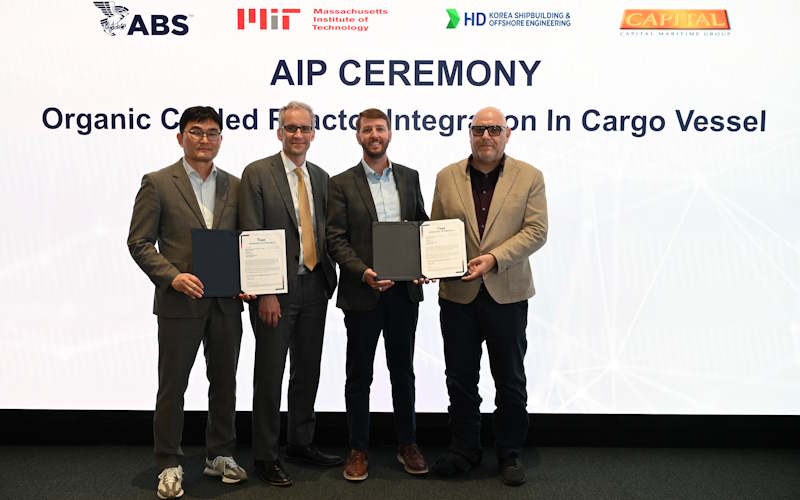
ABS has issued approval in principle (AIP) for the integration of a nuclear reactor into a cargo vessel propulsion system developed by the Massachusetts Institute of Technology (MIT), HD Korea Shipbuilding & Offshore Engineering (HD KSOE) and Capital Maritime Group.
The design uses a special synthetic fluid to carry heat from the reactor core. Today’s designs typically focus on micro-scale thermal outputs of 10MW to 20MW. The MIT design’s near-atmospheric operating pressure can allow for thinner, lighter reactor vessels, supporting modular construction and easier transport.
This is the first AIP to be granted through the MIT Maritime Consortium, where ABS, HD KSOE and Capital Maritime Group are founding members. ABS reviewed the reactor-to-machinery interface based on class requirements. The consortium brings together academia and industry to advance technologies with the potential to reshape the maritime sector, including alternative fuels, new nuclear technologies, data-driven operational strategies, autonomy, cybersecurity and onboard manufacturing.
Patrick Ryan, ABS SVP and CTO, said: “As the industry evaluates new pathways for the future, this approval in principle highlights the value of collaboration with key stakeholders in advancing promising commercial nuclear technologies. The MIT reactor design is an interesting piece of technology. With characteristics that can support modular fabrication and vessel integration, these emerging technologies represent one possible pathway toward the safe, practical development of next-generation commercial shipping solutions.”
Sangmin Park, HD KSOE SVP and Head of Green Energy Research Laboratory, added: “As global environmental regulations tighten, the maritime sector requires paradigm-shifting solutions. Nuclear energy represents one of the most promising alternatives to traditional fossil fuels. Through this successful collaboration with ABS, MIT, and Capital Maritime Group, we are proud to demonstrate our readiness to lead the eco-friendly vessel market by presenting a safe and innovative nuclear-powered shipping solution.”
Stergios Stergiou, Chief Sustainability Officer, Capital Clean Energy Carriers, said: “It is our responsibility as an industry to explore every potential solution, including those that challenge conventional thinking. Nuclear propulsion is one such frontier. Through our membership in the MIT Maritime Consortium alongside ABS and HD KSOE, we are committed to ensuring that any pathway to net zero is grounded in the non-negotiable highest standards of crew safety, vessel integrity, and environmental protection. This AIP is the first step in that process.”
Themis Sapsis, MIT Koch Professor of Marine Technology and Co-director of the Maritime Consortium, concluded: “The MIT Maritime Consortium is a unique collaboration between academia and key industry stakeholders aiming to address critical gaps in the modernisation of the commercial fleet through the development of bold technological solutions, industry standards, and policies. Our reactor design is one of the first concrete outcomes of this synergy, providing a realistic pathway towards nuclear propulsion for commercial vessels.”
The AIP is part of the ABS New Technology Qualification (NTQ) service that provides a structured approach to support the early adoption and implementation of innovative solutions.
Image: (L to R) Sangmin Park, HD KSOE; Jacopo Buongiorno, MIT; Joshua Divin, ABS; and Nikolas Vaporis, Capital Ship Management (source: ABS)