
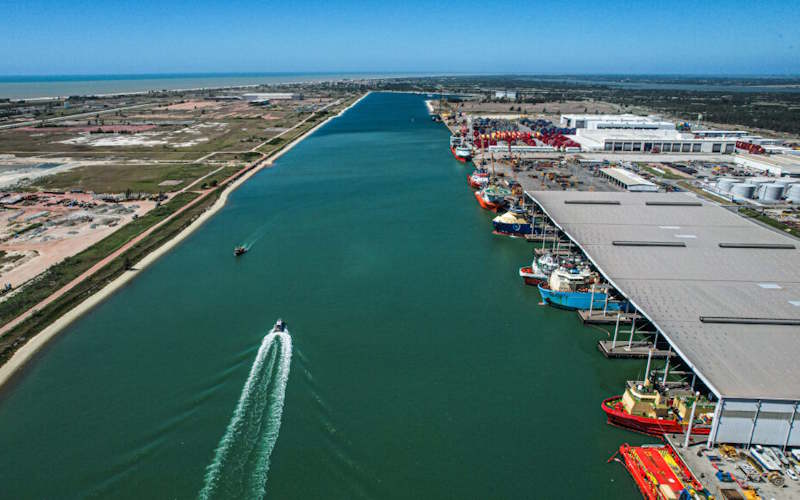
A new consortium facilitated by the Global Maritime Forum (GMF) and RMI will work to establish a green shipping corridor between the Port of Açu in Brazil and the Port of Antwerp-Bruges in Belgium.
In addition to the port teams on both ends of the corridor, the consortium includes HIF Global, Fuella, NYK Line, Höegh Autoliners, and Wallenius Wilhelmsen. The consortium will assess infrastructure, vessels, and business models to create a roadmap for transporting zero-carbon fuels produced in Açu, such as e-ammonia or e-methanol. The transport itself would also be powered by the same zero- or near-zero-emission fuels.
Eleanor Wells, GMF senior project manager, said: “We’re thrilled to be working with these partners to take these important steps towards Brazil’s e-fuel production and bunkering opportunity, whilst supporting the growing demand for e-fuels in Europe.”
The new consortium builds on a pre-feasibility study developed by RMI and the Global Maritime Forum in November 2025. The study highlighted the competitive projected costs of e-fuel produced in Açu, due to Brazilian policies supportive of green hydrogen production, the country’s largely renewable electricity grid, its abundance of renewable energy sources, and a relatively low cost of capital. A 2024 report from the same two organisations, Oceans of Opportunity, identified the Port of Açu as a high-potential e-fuel export hub.
Green shipping corridors are dedicated trade routes where the feasibility of zero-emission shipping is catalysed by public and private action. These routes are seen as central to delivering on the shipping industry’s goal of having zero-emission fuels account for 5% of all fuels by 2030. While green corridors have rapidly expanded in popularity worldwide, and a handful of initiatives have now reached the realisation stage, the most recent edition of the Annual Progress Report on Green Shipping Corridors warned that progress is being stalled by a ‘feasibility wall’ created by the cost gap between conventional and zero-emission fuels.
GMF and RMI will continue to facilitate the realisation of the Açu-Antwerp green corridor, with work already moving at pace to progress beyond pre-feasibility and develop a feasibility analysis for the corridor. The feasibility analysis is expected to be published by the end of the year, with the consortium meeting regularly in the meantime.
Image: Port of Açu is Brazil’s largest privately-owned port complex (source: Port of Açu)