
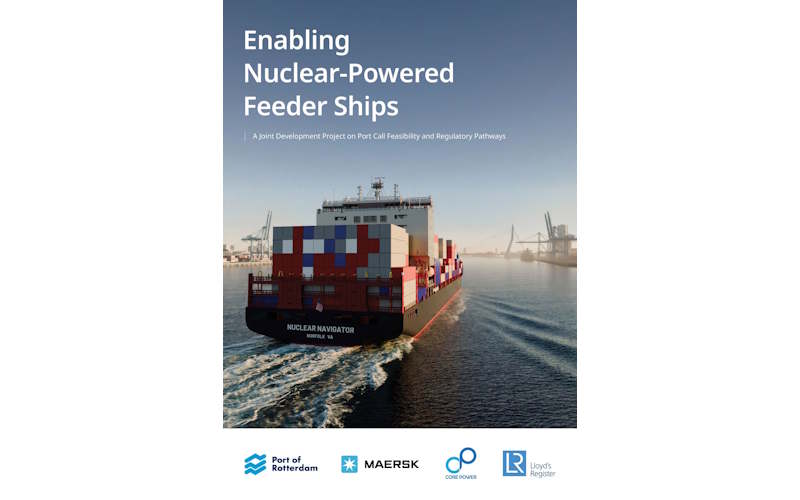
A new joint study using the Port of Rotterdam as a case study ‘Enabling Nuclear-Powered Feeder Ships: A Joint Development Project on Port Call Feasibility and Regulatory Pathways’ has found that existing port safety and risk-management frameworks could provide a credible starting point for assessing nuclear-powered commercial ship calls within a major European port environment.
The desktop study, carried out through a joint development project involving Lloyd’s Register (LR), the Port of Rotterdam Authority, Core Power and A.P. Moller-Maersk, sets out the questions that ports, regulators and industry would need to answer in order to assess nuclear-powered vessels in a structured and responsible way. It identifies further work that would be required before routine operation could be contemplated, including regulatory alignment, emergency preparedness, security, liability and public engagement. Publication comes at a time of growing pressure on the shipping industry to identify more scalable zero-emission technologies capable of meeting increasingly demanding decarbonisation requirements while preserving operational reliability, endurance and flexibility.
The report argues that maritime nuclear propulsion should be evaluated as part of the wider discussion around shipping decarbonisation, energy resilience and long-term industrial competitiveness. While much of the current EU policy discussion has focused on alternative fuels such as hydrogen, ammonia and e-fuels, the report notes that segments of global shipping may ultimately require additional propulsion solutions capable of supporting endurance, reliability and operational flexibility at scale.
The Port of Rotterdam participated as a case study because it provides a real-world European port environment through which to examine how emerging energy and shipping technologies could interact with existing port safety frameworks, operations and regulatory processes.
Importantly, the study concludes that existing risk-based port safety frameworks already familiar to European ports could provide a credible starting point for assessing nuclear-powered vessels, provided nuclear-specific safety, security and operational considerations are systematically integrated and supported by appropriate national and international guidance.
The findings suggest that the real challenge for future maritime nuclear propulsion is likely to centre on regulatory alignment, governance, integration between nuclear and maritime safety regimes, and public and institutional preparedness.
The study identifies several key findings:
- Existing port safety and risk-management frameworks provide a credible starting point for the assessment of nuclear-powered commercial vessels within the defined case study scenario.
- Further work is needed on regulatory alignment, governance coordination, nuclear-specific safety and security, emergency preparedness, liability and insurance, operational integration and public engagement before routine commercial operation could be contemplated.
- Current IMO provisions relating to nuclear-powered ships were developed for an earlier era and require modernisation to support any future civil commercial nuclear propulsion pathway.
- Current European maritime decarbonisation discussions remain heavily focused on alternative fuels, with comparatively limited consideration of high-density, zero-emission propulsion systems capable of supporting long-range and high-utilisation shipping operations.
- Major ports and maritime member states may play an important role in shaping how nuclear propulsion is assessed and potentially integrated into future shipping strategies.
The early-stage work examined a defined feeder vessel concept, assumed operating scenario, port-call profile and regulatory context. It is however not a licensing assessment, an endorsement of deployment, or a final safety or security case.
Mikal Bøe, CEO Core Power, said: “An obvious key to the success of civil maritime nuclear propulsion is the trusted confidence of port cities and their populations in ship calls by nuclear powered merchant ships. Together with Rotterdam, LR and Maersk we’ve identified a port safety framework and created a credible starting point for assessments by the IMO as it revises the Safety Code for Nuclear Ships and for the IAEA as it launches its flagship Atlas program this summer. We’ve highlighted where further work is needed, including modernized port guidance, inter agency regulatory alignment, nuclear-specific safety, and security requirements and best in class emergency preparedness to build public trust. That trust and confidence is fundamental if we’re going to transform the future civil shipping sector. Greenhouse gas emissions from the existing shipping fleet have become unsustainable and have led to the slowest sailing times we’ve seen in decades. Now is the time to start the important work of evaluating nuclear shipping in a modern context and this report does exactly that”.
Port of Rotterdam Harbour Master René de Vries added: “Ports need to understand how emerging energy and shipping technologies may interact with future port operations and industrial systems. This study represents an initial case-study assessment intended to better understand the regulatory, operational and safety considerations associated with nuclear-powered commercial shipping within a European port context.”
Meg Albrecht, LR Senior Engineer, Nuclear Technology and Alternative Fuels, said: “The maritime energy transition will require the industry to examine a range of future fuel and propulsion pathways. This work contributes to a broader understanding of the regulatory and operational considerations associated with nuclear-powered vessels and helps establish a structured basis for further discussion and analysis.”
Ole Graa Jakobsen, Head of Fleet Technology, A.P. Moller-Maersk, concluded: “Shipping’s long-term energy transition will require the consideration of multiple fuel and technology pathways. Civil commercial nuclear propulsion presents a number of significant challenges, including safety, waste management, regulatory alignment and public acceptance across regions. This study does not represent a decision to pursue nuclear propulsion, but contributes to further understanding of what would be required for ports and authorities to assess such vessels in a structured and responsible way. We continue to monitor and assess this technology alongside other low-emission solutions.”