
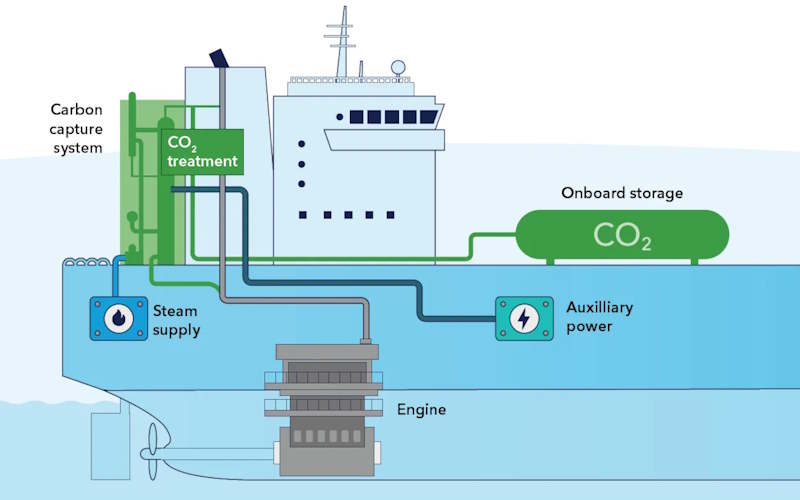
DNV has published a recommended practice (RP) providing a standardised framework for measuring and verifying the performance of onboard carbon capture and storage (OCCS) systems on ships, setting the stage for further developing onboard captured carbon solutions and technologies.
DNV’s Alternative Fuels Insight has estimated that around 90% of the operational fleet still depends on fossil fuels, so OCCS is emerging as a viable pathway to reduced emissions for vessels that cannot easily or economically transition to low-GHG fuels. On the regulatory side, IMO has initiated work on guidelines for OCCS, with development ongoing and expected to be completed by 2028.
Cristina Saenz de Santa Maria, DNV Maritime CEO, said: “OCCS has potential as a pathway for a large part of the existing fleet, and that matters given how long many of those vessels will remain in service. Our Maritime Forecast to 2050 estimates that developing CO2 offloading infrastructure at just 20 of the world’s largest ports could reduce total world fleet CO2 emissions by 9%. With this recommended practice, we want to give the industry a shared technical language, and in doing so, support further development of onboard carbon capture solutions.”
The DNV‑RP‑0698 Performance of onboard carbon capture and storage systems is built around mass balance principles and defines a harmonised set of performance metrics, including capture rate, captured CO2 quantity, emissions to atmosphere, and gross capture efficiency. The framework is technology-neutral, covering pre-combustion, post-combustion, oxy-fuel and other approaches. Finally, a structured third-party verification process covers system documentation, measurement setup, performance calculations and uncertainty evaluation.
Chara Georgopoulou, DNV Greece Head of Maritime R&D and Advisory, added: “This recommended practice provides a structured way to account for the full performance picture, not just capture volume. It enables designers, yards, OCCS manufacturers, and owners to define and verify performance in newbuild and retrofit projects, supporting alignment between stakeholders early in system design and more informed investment and deployment decisions.”
More information on DNV’s new RP can be found here.
Image: Diagrammatic view of OCCS (source: DNV)
www.dnv.com/rules-standards/