
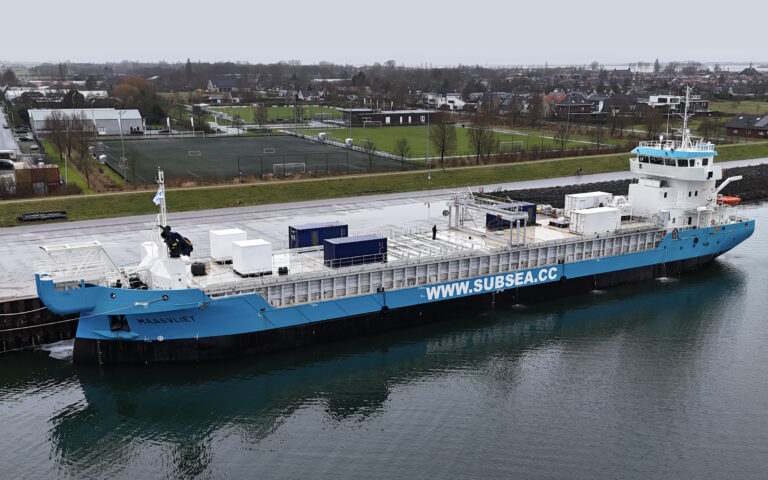
Dutch marine engineering company’s CIP3800 platform design was envisaged as part of the standardized Conoship International Projects (CIP) series, intended as a robust, future-proof general cargo vessel capable of achieving 20% to 30% reduction in fuel consumption and a corresponding cut in emissions.
However, recognising the latent potential of an ultra-efficient hull form and diesel-electric plant, Subsea Environmental Services and Hudig & Veder in collaboration with Holland Shipyards Groups approached the market with a compelling question: could this general cargo platform be successfully adapted into a highly specialised submarine cable recovery ship? It was an unconventional combination, but Conoship’s integration experience provided a solution. Now, after 12 months of real-world operations, the empirical data proves that the platform excels in adaptability and efficiency.
Across a direct voyage comparison encompassing transit, low-speed cable recovery, and offloading, the Maasvliet achieved an overall 53.6% reduction in fuel consumption compared to traditionally powered craft. In concrete financial terms, this translates to an approximate saving of 600t of MGO and US$ 1m in operating costs in one year.
According to Conoship, the success of the Maasvliet answers a strategic question for modern shipowners: Does a specialised operational profile require a 100% custom, expensive newbuild design? Conoship believes the answer lies in the inherent flexibility of its CIP series design. It was created from the ground up around qualities extending beyond cargo transport: optimised hull lines for low resistance, sea-keeping capabilities, and a modular diesel-electric power architecture. Conoship was able to integrate Subsea’s specialised cable-handling equipment, upgrade the bow thrusters for 24/7 station-keeping, and reconfigure the internal spaces for long-endurance crew comfort, without losing the CIP platform’s core strengths.
With the maritime sector wrestling with ageing legacy fleets and volatile energy prices, the Maasvliet demonstrates that a fully bespoke design for every niche market is not necessary; by leveraging a standardised, bankable platform like the CIP-Series, shipowners can reduce technical risk, lower initial engineering timelines, and secure predictable returns.
Image: ‘Maasvliet’ cable recovery vessel (source: Conoship)