
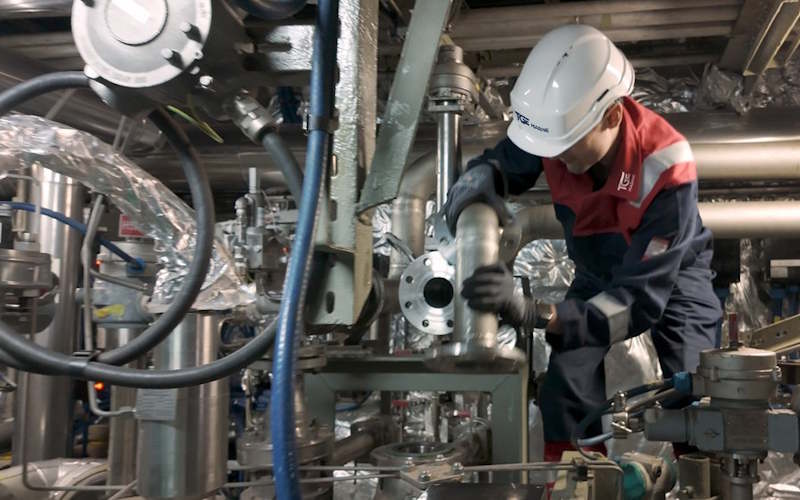
Mitsui E&S has decided to expand its ammonia fuel supply system facilities for land-based testing in preparation for the projected growth in demand for marine engines fuelled by ammonia.
With reducing GHG emissions from vessels becoming a critical challenge. Mitsui E&S currently claims the largest Japanese production volume of large marine dual-fuel engines using low-CO₂ fuels such as LNG, LPG, and methanol: all of which are compatible with future net-zero emission fuels. Through the investment in this facility, Mitsui E&S aims to further develop and increase its production capabilities for ammonia-fuelled engines, which are expected to become a key zero-emission fuel in the future.
The facility will incorporate technologies from TGE Marine Gas Engineering, a wholly owned subsidiary of Mitsui E&S. TGE Marine has over 150 Fuel Gas Systems delivered or on order for LNG, LPG, ethane and ammonia.
To date, Mitsui E&S has been advancing development of ammonia fuel supply systems and ammonia fuel tanks under the NEDO Green Innovation Fund. By the end of 2025, Mitsui E&S had conducted integrated operation testing of ammonia-fuelled engines and fuel supply systems at its Tamano Works. Going forward, Mitsui E&S will conduct further integrated testing and validation of engines and fuel supply systems through land-based trials. This is expected to contribute to enhanced reliability, safety, and wider adoption of ammonia propulsion systems in marine applications.
In addition, through collaboration with TGE Marine, Mitsui E&S will provide integrated marine propulsion systems combining engines and fuel supply systems, enabling it to meet diverse customer needs both in Japan and globally. Mitsui E&S aims to evolve from a conventional standalone engine business into a comprehensive marine propulsion system supplier as well as expanding its range of services and solutions to grow its market presence while enhancing its corporate value and contributing to the realisation of a sustainable future.
The capital investment is supported by the Zero-Emission Ships Construction Promotion Project, a joint initiative by the Japanese Ministries of the Environment and of Land, Infrastructure, Transport and Tourism.
Image: TGE Marine fuel system (source: TGE Marine Gas Engineering)