
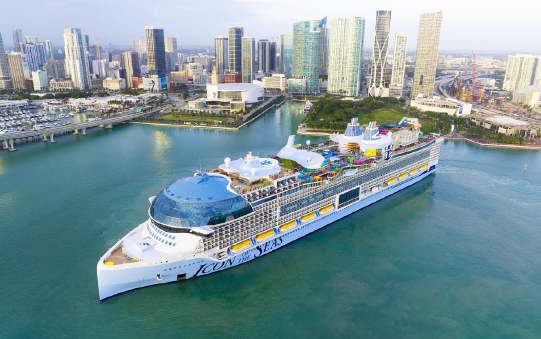
A second incinerator installed on ‘Icon of the Seas’ has significantly increased its waste-handling capacity, while reducing the emissions associated with landside waste handling.
Evac delivered the first-of-its-kind retrofit as the vessel remained in continuous operation. Royal Caribbean’s Icon of the Seas entered service in early 2024, sailing week-long itineraries out of Miami. As the ship settled into this weekly operation, it quickly became apparent that the volume of waste generated on each voyage exceeded the capacity of the onboard processing system. The ship had been fitted with a single incinerator to manage its burnable waste stream. With the incinerator unable to keep pace, large quantities of cardboard, plastics and USDA-regulated food waste quickly accumulated and had to be offloaded in Miami. The ship was landing an average of 222 pallets of waste per week – sometimes close to 400 pallets – resulting in significant weekly offload spend.
Landing this volume of waste increased onshore emissions. Evac’s modelling shows that road transport emissions accumulate rapidly, reaching parity with onboard incineration after approximately 1,800 km of diesel truck travel. This makes landside handling a material contributor to a vessel’s environmental footprint. Faced with these costs and the emissions impact, Royal Caribbean made the decision to install a second incinerator on board. The challenge was to find a solution that could be integrated within the vessel’s existing technical spaces and installed without taking the ship out of service. This required exceptional engineering and project-management expertise.
Simon Hamilton, Senior Project Manager Royal Caribbean, said: “Incinerators from Evac are used on at least 20 vessels in the Royal Caribbean fleet. The equipment has supported our operations on Oasis- and Quantum-class ships for many years. To perform the complex retrofit on Icon of the Seas, we went with what we knew.”
According to Evac, delivering a full marine incinerator retrofit on a cruise ship that remained in continuous operation had not been done before. Engineering, installation and commissioning had to be carefully sequenced and executed without disrupting the vessel’s sailing schedule. Finding space for the new three-deck system, comprising a shredder, a waste silo and an incineration chamber, required meticulous planning within the ship’s internal layout. Routing the 800mm exhaust pipe up to Deck 19 added further complexity, as it had to pass through finished areas already used by guests.
Adding to the challenge, the incinerator could not be lifted onboard in pre-assembled sections. Internal doorways were simply too small. The system would need to be broken down into components and assembled onboard. All planning and execution had to align with the ship’s weekly turnaround in Miami, while installation would be carried out during voyages.
The system was delivered in 127 pallets, each sized to pass through the ship’s internal spaces. Components were manufactured in Hungary and shipped in sequenced batches with deliveriesplanned for weekly Miami turnarounds. Coordination between Evac, Royal Caribbean and installation contractor LTH-Baas was maintained through regular project meetings.
Hamilton said: “The coordination between Evac, our team and LTH-Baas was brilliant. Everything was planned in batches and sequenced perfectly. The Evac team reacted extremely fast to the issues we ran into, with no impact on the overall schedule. They fixed a refractory issue within a week and handled a fan incident without any bureaucracy.”
After commissioning Evac’s system, the weekly offload of waste for treatment onshore had dropped to around 60 pallets. While incineration represents only a small share of a vessel’s overall emissions profile, managing regulated waste at source avoids the cumulative emissions from bringing large volumes ashore.
The project is thought to be the first in-service installation of a full marine incinerator on a ship of this size. It demonstrates that large-scale waste-processing upgrades can be delivered without dry-dock time, opening new possibilities for fleet-wide retrofits.
Kjell Erik Reinstad, Director Strategic Accounts, Cruise, Evac Group, concluded: “Aside from the operational benefits, the retrofit reduces emissions by limiting the need to land and handle large volumes of regulated, non-recyclable waste ashore. This project shows that major retrofits no longer need to be tied to dry-dock schedules. With support from Evac, vessel operators can approach upgrades without disrupting commercial operations.”
Image: ‘Icon of the Seas’ has benefited from a second waste treatment plant from Evac (source: Evac Group)