
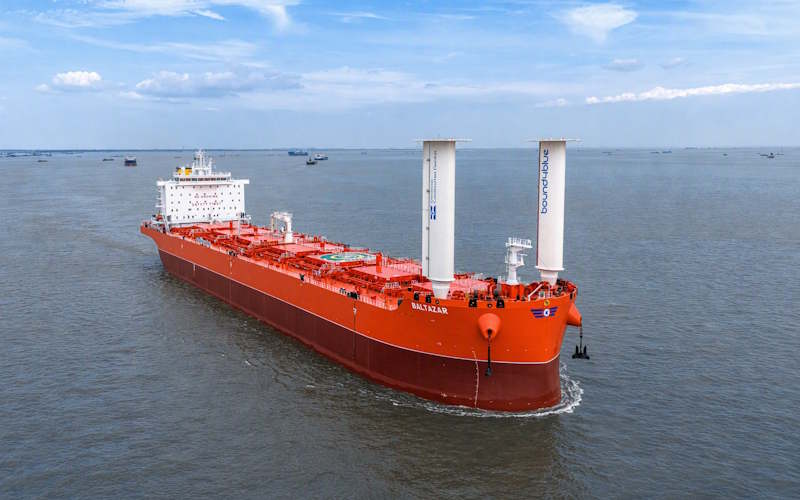
Klaveness Combination Carriers (KCC) has taken delivery of ‘Baltazar’, its third and final contracted third-generation Cabu vessel, from New Yangzi Shipyard in China.
Equipped with the first wind-assisted propulsion system in KCC’s fleet and a range of advanced energy efficiency technologies, Baltazar completes the Cabu III newbuilding programme and brings KCC’s fleet to 19 combination carriers. Designed for trades carrying caustic soda solution to Australia and returning with dry bulk commodities, the vessel offers around a 35% lower carbon footprint and approximately 20% higher earnings capacity than KCC’s first-generation Cabu vessels.
Like her sister vessels Balder and Bastion, Baltazar incorporates a range of energy efficiency measures including an air lubrication system, a shaft generator, an EcoEGR fuel-optimised main engine, and a Mewis duct. In addition, the vessel is fitted with two bound4blue eSail suction sails, making it the first vessel in KCC’s fleet to use wind-assisted propulsion systems (WAPS). The vessel is prepared for future retrofitting to enable the use of zero or near-zero emission fuels.
With the delivery of Baltazar, KCC now operates a full fleet of 11 Cabu and eight Cleanbu combination carriers. Baltazar builds on decades of combination carrier operations in Australia, where KCC’s ability to combine wet and dry bulk cargoes results in highly efficient trading with limited ballasting. The Cabu activities have become an integrated part of the aluminium value chain supporting customers’ supply chains and long-term logistics planning. With these three Cabu newbuilds, KCC’s service will further improve flexibility and cost efficiency of the scope three emissions of its customers’ ocean freight. Reflecting the importance of these trades and KCC’s longstanding presence in the region, following Baltazar’s maiden voyage, KCC will host customers, partners and industry stakeholders for the vessel’s naming ceremony in Fremantle, Western Australia.
KCC’s combination carriers typically emit up to 35% less CO₂ per transported ton compared to standard tanker and dry bulk vessels in current and targeted combination trading patterns.
Image: ‘Baltazar’ on sea trials (source: Klaveness Combination Carriers)