
According to Ossi Mettälä, Product Manager Shipping Solutions, Napa, the maritime industry is navigating one of the most complex operating environments it has ever faced.
Tightening regulations, commercial pressure, and expectations around efficiency are all converging at once. As these challenges continue to be discussed far and wide, myths and misconceptions can arise. In this environment, believing myths can be expensive too. They can delay decisions, discourage investment, and prevent shipowners and operators from using proven tools that improve performance across the fleet.
From FuelEU Maritime and fleet renewal strategies to voyage optimisation and wind-assisted propulsion technology, there are clear areas where practical technology, actionable data, and the right operational strategy can optimise performance and deliver value today.
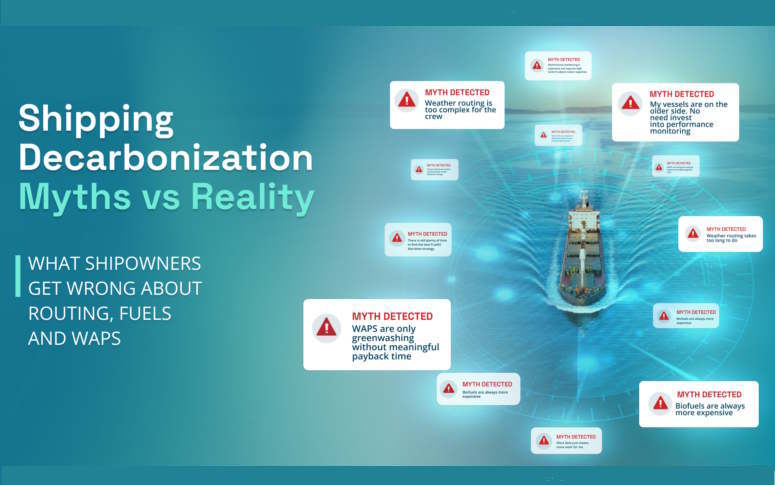
The seven myths identified by Napa are as follows:
- ‘Weather routing is too complex for the crew’: Modern routing tools are designed to be approachable and practical to use. The aim is not to create more work for the crew, but to support them with clearer, faster, and better-informed decisions.
- ‘Weather routing takes too long to do’: Current routing tools enable crews to access timely weather forecasts and run route optimisation in minutes, while taking into account routing restrictions and safety requirements. Manual plotting on a chart takes time, algorithmic optimisation takes seconds.
- ‘I don’t need weather routing in my operations’: This common misconception or assumption, especially on short-sea trades or fixed routes, overlooks how much weather and sea conditions still affect safety, timing, and fuel efficiency. Weather routing is not only for unusual voyages or difficult conditions, but is a practical way to build more efficient trading patterns.
- ‘There is still plenty of time to find the best FuelEU Maritime strategy’: Waiting until the penalties hit is the most expensive way to navigate FuelEU Maritime, and compliance trajectories will only tighten over time. Penalties are high enough to encourage investment in alternative fuels. Achieving over-compliance today unlocks commercial benefits via banking and pooling mechanisms.
- ‘WAPS are only greenwashing without meaningful payback time’: Wind-assisted propulsion systems (WAPS) are increasingly mature and have moved far beyond the experimental or even pilot phase. Validated fuel savings are already being seen. To reach their full decarbonisation potential, WAPS must be paired with voyage optimisation technology. The payback period should be calculated before installation based on the vessel’s design and intended operations; the ROI calculated for one will not necessarily apply to another. WAPS are a tangible way of achieving fuel savings, and GHG emissions reductions today.
- ‘Biofuels are always more expensive’: The spot price of biofuels may be higher, as with all alternative marine fuels, but the biofuel option gives ship operators resilience against energy price spikes. Factoring in the cost of compliance is more important than bunker price alone; once EU ETS savings and FuelEU Maritime penalties are considered, the option that first appears more expensive can often become commercially viable.
- ‘My vessels are on the older side, so there’s no need to invest in performance monitoring’: Older ships are under the same regulatory pressure as the rest of the fleet, including frameworks such as CII and FuelEU Maritime. Improving how those vessels operate is often a more cost-effective option than relying only on expensive retrofits, alternative fuels, or early vessel replacement.
Mettälä said: “The maritime industry does not need more noise around digitalisation, decarbonisation, and performance. It needs practical thinking, reliable tools, and a clear understanding of what actually delivers return on investment.”
Napa’s full myth-busting suggestions can be read here.
Image: Seven myths about decarbonisation (source: Napa)