
The current low water levels in Europe’s rivers are emphasising the need to take action – the German government should support a long-term funding framework and a European drive for modernisation, according to inland shipping company HGK Shipping.
In the light of the low water levels in the river Rhine, HKG Shipping is calling for a long-term fleet renewal programme for commercial inland waterway shipping. The goal should be to mobilise investments in up to 1,000 modern, energy-efficient and future-oriented commercial inland waterway vessels, which are optimised to operate in shallow waters in Europe by 2035 – and, at the same time, strengthen European shipbuilding capacities. The German government should, says HGK, play a leading role in this process and trigger private investments in the fleet renewal programme with a reliable long-term funding framework.
The Middle Rhine is currently illustrating the size of the challenge. Only 16cm were measured at the Kaub water measurement point on 11 August. The forecasts suggest that the situation will deteriorate further and water levels will reach single-digit figures. Falling water levels are massively reducing the possible loads and therefore transport capacities on one of the most important European transport routes. Vessels that are optimised to operate in shallow waters make the crucial difference here. Nine vessels, which are optimised to operate in shallow waters and have been developed with customers at HGK’s in-house Shipping Design Centre since 2018, are considered a significant reference point for further projects.
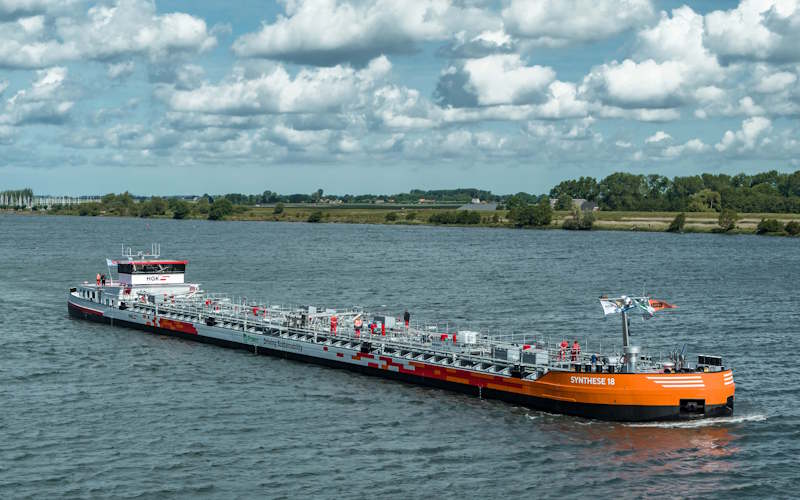
HGK Group CEO Steffen Bauer said: “We’re seeing right now what a modern fleet can achieve: our Synthese 18 is still transporting a load weighing 485t, even at the current extreme conditions at Kaub water measurement point. Let’s just imagine that we didn’t have this kind of capability, not just on individual vessels, but in relevant parts of our European fleet. That’s exactly what’s at stake with our demand for as many as 1,000 modern vessels: keeping industrial supply chains moving for longer, even if water levels are extremely low.”
The current shallow water levels in the river Rhine in 2026 are thought to be inhibiting German economic growth to a tangible degree. The present scale of the estimates is roughly a fall in GDP growth of 0.3 and 0.4 percentage points if the extreme low-water levels persist. The Kiel Institute for the World Economy estimates that the possible economic damage from the low water levels in the 3rd quarter will be as high as €bn.
There is also a need to act in terms of structure. According to numbers published by the Central Commission for the Navigation of the Rhine (ZKR), the fleet conveying dry and liquid goods for the countries bordering the river Rhine involves approximately 7,800 vessels. About 80% of the dry goods fleet was constructed in the 20th century. In addition, only 13 new dry goods vessels and 38 new tankers came on to the market in 2024.
The small and medium-sized structure of the sector is an additional factor. A significant proportion of the fleet is operated by small and medium-sized companies as well as self-employed vessel owners and operators alongside larger shipping companies. The high investment sums and long amortisation periods for new modern vessels represent a significant hurdle, particularly for these companies.
Bauer added: “We cannot prevent low water levels. But we can build vessels that are still capable of operating for longer in difficult conditions. If we want to modernise the fleet, we must also enable small and medium-sized companies and self-employed vessel owners and operators to invest in the next generation of vessels.”
HGK Shipping management is convinced that a modern fleet must be resilient, efficient and future-fuel-ready – i.e. able to cope with future, climate-friendly drive systems and energy sources. At the same time, innovative vessel concepts must enable vessel owners to tap into new markets: e.g. for recycling and circular economy goods, alternative energy sources, project and heavy-duty goods as well as high-grade industrial goods. This will create additional potential to transfer shipments to the inland waterways.
HGK is therefore suggesting a long-term ‘Fleet Renewal Programme for Commercial Inland Waterway Shipping 2035’. The goal should be to mobilise investments in as many as 1,000 modern, commercial inland waterway vessels in Europe by 2035. This kind of programme would create demand for modern vessels and make a contribution towards safeguarding and further developing European shipbuilding capabilities and technical expertise. If an average investment volume of €12.5m for each new vessel is taken as the basis for classification purposes, this target figure is thought to correspond to investment potential of as much as €12.5bn.
HGK believes that there is a need for a reliable and adequately dimensioned funding framework in the long term, which particularly also enables small and medium-sized companies and self-employed vessel owners and operators to invest in new modern ships. Funding rates of as much as 40% should be examined and fully exploited as part of the opportunities provided by state aid rules.
Bauer concluded: “The modernisation of the fleet is a European task – but Germany must take a lead in this process. We need a reliable investment framework from the German government up to 2035, which mobilises private capital and provides companies with planning certainty for building new vessels. This will enable us to strengthen the resilience of our supply chains and, at the same time, reinforce industrial wealth creation and shipbuilding expertise in Europe.”
The current government programme for green inland waterway shipping, which initially provides €125m, forms an important basis, but neglects the necessary adjustments for long-term shallow water phases. It is now crucial to create a future opportunity that goes beyond individual funding and legislative periods. But a fleet renewal programme does not replace the investments that are necessary for Germany’s inland waterways.
Image: HGK Shipping’s ‘Synthese 18’ continues to transport goods even under the current extreme conditions (credit: HGK Shipping)