
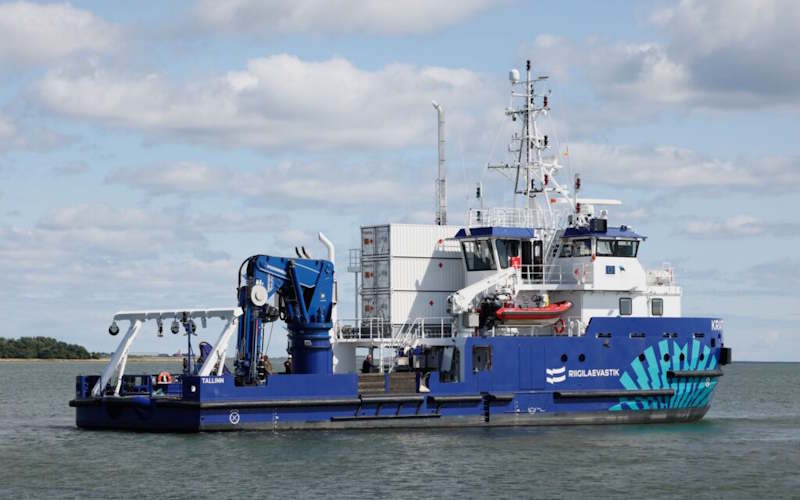
With the official delivery of the 38meter multipurpose vessel ‘Kratt’ to the Estonian State Fleet (Riigilaevastik), Dutch ship designer Conoship International says that a new benchmark for low-emission public sector vessels has entered Baltic waters.
Built by Baltic Workboats, Kratt replaces single-purpose state vessels with a single, adaptable platform. Conoship delivered the engineering scope for the project, covering the basic design and detailed design for structural and piping, regulatory support, shipyard support, and the compressed biomethane (CBM) Hazid safety assessment.
Margus Vanaselja, Chairman, Management Board, Baltic Workboats, said: “During the vessel’s construction, it was important to find a solution that would combine the high operational capability and versatility of a workboat with a reduced environmental impact.”
Combining buoy handling, fairway maintenance, oil spill response, search and rescue (SAR), and marine research into a compact 38m hull involved careful weight distribution and space management. The vessel now features a 15t deck crane, specialised survey gear, and pollution recovery systems, without compromising stability or operational efficiency.
Running four 350-kW gas generators on Compressed Biomethane (CBM) alongside a 400kWh battery system required a clear safety framework. Conoship conducted the CBM Hazid (hazard Identification), defining safety zones and risk mitigation measures for gaseous fuel storage and piping onboard. Working alongside flag state authorities and class rules, the engineering team managed the regulatory compliance process to ensure the design met all applicable safety standards prior to construction.
Throughout the build phase, Conoship provided ongoing engineering support to Baltic Workboats, addressing technical queries and adjusting production drawings to keep the construction process on schedule.
Image: Gas-fuelled multipurpose vessel ‘Kratt’ (source: Conoship International)