
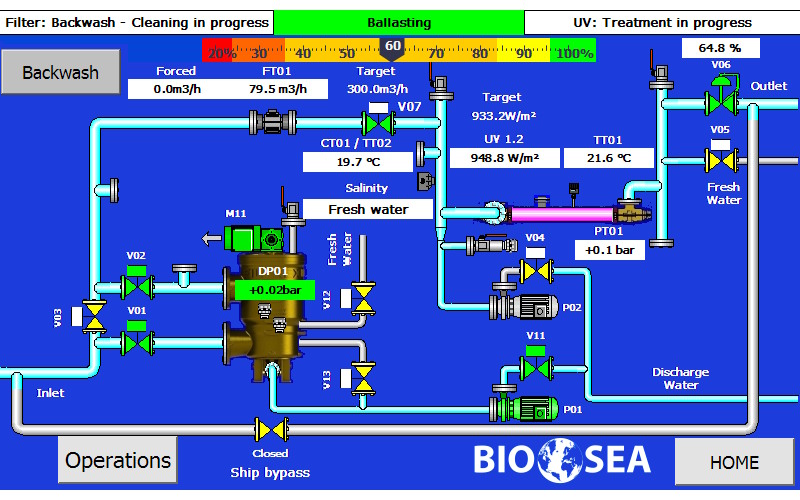
Bio-UV Group has upgraded the control system for its Bio-Sea ballast water management system (BWMS), introducing new features to help crews identify changes in treatment capacity and filter performance when operating in challenging water conditions.
The new Bio-Sea control panel features a colour-coded ‘traffic light’ display showing treatment capacity as a percentage of full flow. The development follows recommendations of the CWQ (challenging water quality) guidelines introduced by IMO.
When a Bio-Sea BWTS is operating, the new software displays four levels of operation (green, yellow, orange, dark orange) before going to red (critical alarm), when the system stops. Thresholds are configured during commissioning according to treatment mode (IMO or USCG) through a new CWQ parameter screen.
Charlène Ceresola, Bio-UV Group Project Manager, said: “We have focused on giving the crew a much clearer picture of what is happening during ballast water treatment, particularly when water quality becomes more challenging for UV treatment. The operator can see available treatment capacity directly on the process screen and respond to changing conditions without having to interpret a series of individual sensor values.”
Filter loading is monitored through the same visual approach, using backwash frequency as the indicator of the challenge posed by particle load, from 40-minute intervals through to continuous backwashing. Red still indicates a clogged filter and generates an alarm, but preventive pop-ups help to better identify when the self-cleaning function is getting challenged.
Ceresola added: “The upgraded human-machine interface (HMI) better separates information from the most recent ballast water treatment operation from cumulative system data. The first screen records date, duration, location, treatment mode, treated volume and energy consumption for the latest operation and resets automatically when the next operation begins. A second provides treated volume, treatment duration, maintenance information and energy consumption accumulated since commissioning, which cannot be reset. This gives operators two distinct sets of information: what happened during the latest operation and the accumulated operating record of the system. Together with the alarm and filter information, it provides the crew with a more accessible operational picture to handle their reporting obligations in ballast water record book.”
Cybersecurity features are still accessible through Bio-Sea HIGH mode in line with IACS UR E26 standards.
Ceresola said: “Ship-specific and class requirements can differ, which is why the user management system can be configured accordingly at commissioning.”
Image: Bio-Sea’s new control panel (source: Bio-UV Group)