
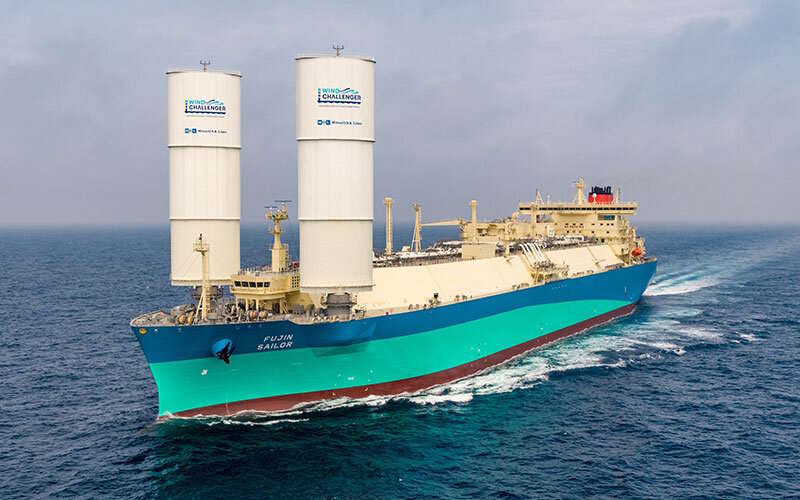
Mitsui OSK Lines (MOL) thas held a naming ceremony at Hanwha Ocean’s Geoje Shipyard in South Korea for ‘Fujin Sailor’, said to be the world’s first LNG carrier equipped with two Wind Challenger hard sail wind-assisted propulsion systems (WAPS).
The vessel will be delivered under a long-term charter contract to Chevron Corporation (Chevron) at the end of September 2026. The Wind Challenger system is expected to reduce fuel consumption and associated GHG emissions compared with conventional propulsion alone.
The vessel is believed to be the first LNG carrier equipped with WAPS, and also the first vessel of any type equipped with twin Wind Challenger units. It is the fourth of a total of 11 MOL Group vessels that have been or will be equipped with the Wind Challenger. The vessel is claimed to represent a significant milestone in the application of WAPS technology to LNG transportation and reflects the collaborative efforts of MOL, Chevron and Hanwha Ocean to bring practical maritime innovation from concept to commercial operation.
Molly T. Laegeler, President, Supply and Trading, Chevron, said: “Reliable energy supply depends on trusted partnerships and continuous innovation. We are proud to celebrate this milestone with our partners at MOL and Hanwha Ocean. Fujin Sailor represents the combined efforts of many and demonstrates how practical innovation can help reduce the carbon intensity of LNG transportation while supporting the safe and reliable delivery of energy around the world.”
Makoto Inomoto, Managing Executive Officer LNG and Ethane Business, MOL, added: “I would like to express my sincere gratitude to Hanwha Ocean for its strong technical support in realising the ground-breaking innovative of installing the Wind Challenger on the vessel, as well as to Chevron for their understanding and cooperation in making this project possible. Fujin Sailor plays a vital role in ensuring a stable energy supply while advancing efforts to reduce the environmental impact of LNG shipping. Through the installation of wind-assisted propulsion technology, this vessel represents a new milestone in innovation of LNG carriers and is expected to contribute to the greater integration of new technologies to support GHG management in LNG transportation.”
MOL has set the target of achieving net-zero GHG emissions by 2050, including plans to launch 25 vessels equipped with Wind Challenger by 2030, increasing to 80 by 2035.
Image: ‘Fujin Sailor’ (source: Mitsui OSK Lines)