
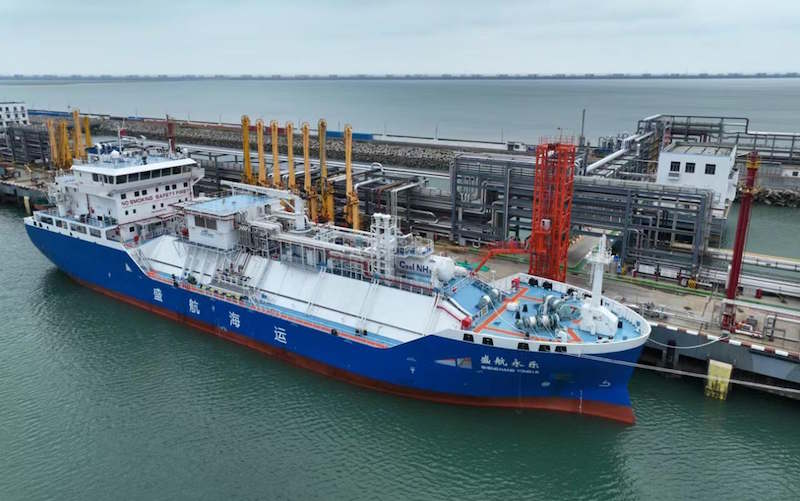
The L21 ammonia carrier ‘Shenghang Yongle’, designed by FKAB Marine Design of Sweden, has been converted for ship-to-ship liquid ammonia fuel bunkering.
Led by Jiangsu Andefu Energy Development, FKAB together with cargo handling supplier Gloryholder provided technical drawing documentation for the conversion. The vessel is now believed to be the world’s first operational ammonia bunker vessel and has received the first ammonia bunkering class certificate.
The achievement is considered an important step in the development of the infrastructure needed to support ammonia as a marine fuel. While several ammonia bunker vessel projects have reached the design, feasibility or construction stage, the Shenghang Yongle has now progressed into operational readiness. Originally designed as a flexible liquefied gas carrier, the vessel has been upgraded from a conventional ammonia carrier into a dual-purpose vessel capable of both transporting liquid ammonia and delivering it as fuel through ship-to-ship bunkering.
Shenghang Yongle is a 5,500 m³ semi-refrigerated and semi-pressurised liquefied gas carrier. The vessel was designed by FKAB, built by China Merchants Shipbuilding Industry Dingheng shipyard and is managed by Shenghang Shipping. Designed for unrestricted navigation, the vessel can carry several liquefied gas cargoes, including ammonia, LPG and vinyl chloride monomer. Its cargo tanks have a minimum design temperature of −48°C, and the vessel is equipped with two low-temperature reliquefication systems. These characteristics provided a strong technical foundation for the subsequent conversion. The vessel’s existing cargo containment and handling capabilities could be adapted to meet the additional requirements associated with transferring ammonia as a marine fuel.
Jiangsu Andefu Energy Development led the conversion and certification process in close cooperation with China Classification Society, while FKAB together with Gloryholder prepared the documentation required for the conversion. The overall work included modifications to the bunkering system, development of operating procedures, risk assessments, and the establishment of safety and emergency-response arrangements. Particular attention was given to the challenges associated with ammonia, including toxicity, material compatibility, low-temperature operation, leak detection and risk control during bunkering.
Ammonia is regarded as one of the more promising potential zero-carbon marine fuels when produced using renewable energy. Its wider adoption, however, depends not only on ammonia-capable ships but also on a safe and reliable supply chain, including production, storage, transport and bunkering. The lack of operational ammonia bunkering vessels has been one of the important gaps in this chain. The conversion of the Shenghang Yongle demonstrates how an existing ammonia-capable gas carrier can be developed into a practical bunkering asset.
For FKAB, the project demonstrates both the long-term value of designing vessels with operational flexibility in mind and the importance of maintaining detailed knowledge throughout a vessel’s lifecycle. Having developed the original vessel design, FKAB was able to support its next stage by preparing the technical drawing documentation for the ammonia bunkering conversion. Shenghang Yongle was designed and built as a capable, versatile working vessel. Its conversion into an ammonia bunker vessel shows how robust naval architecture, adaptable cargo systems and carefully developed conversion documentation can help turn the marine energy transition into operational reality.
Image: Ammonia bunker vessel ‘Shenghang Yongle’ (source: FKAB Design)