
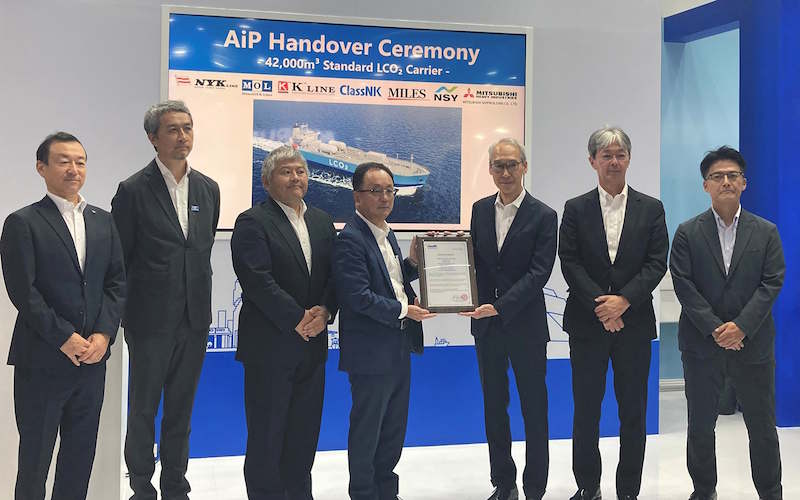
Six Japanese companies, including Mitsubishi Shipbuilding, part of Mitsubishi Heavy Industries (MHI) Group, Kawasaki Kisen Kaisha (‘K’ Line), Mitsui OSK Lines (MOL), Nippon Yusen Kabushiki Kaisha (NYK Line), Nihon Shipyard (NSY) and MILES (a joint venture for the design of liquefied CO2 (LCO2) carriers and low-carbon fuelled ships) have acquired approval in principle (AiP) for a low-pressure LCO2 carrier from ClassNK following completion of a risk assessment for LCO2 handling operations.
According to Mitsubishi, demand for LCO2 carriers is expected to grow as a series of CCS (CO2 capture and storage) projects commence in Japan, requiring a means of transporting CO2 captured in Japan to storage sites. Based on a memorandum of understanding announced in 2025, the six companies have been advancing a standard design framework that uses MILES for LCO2 carriers and alternative-fuel ships. The goals include the stable domestic construction and supply of LCO2 carriers, the standardisation of LCO2 carriers, and the establishment of a CCS value chain. The AiP is said to mark the first concrete achievement through the MILES framework.
The six companies conducted a risk assessment for LCO2 handling operations on a low-pressure 42,000m³ LCO2 carrier, which is being standardised. The risk assessment drew on the experience of ‘K’ Line, MOL, and NYK Line in low-pressure gas carrier operations to consider the risks unique to low-pressure LCO2. A design policy stressing safety was established based on the findings, leading to the acquisition of the AiP. This policy will be reflected in the standard design of LCO2 carriers and will serve as an important foundation for supporting CCS business development in Japan. A common design platform for a standard vessel is expected to provide workload savings and greater efficiency in design and construction going forward, strengthening construction capabilities.
MHI Group is implementing strategic measures to strengthen its energy transition business. Mitsubishi Shipbuilding plays a key role in this undertaking, and aims to contribute to the development of the maritime industry in Japan and overseas through maritime engineering technology based on shipbuilding, as well as its conventional shipbuilding. This initiative is part of that effort. Through collaboration with related companies, both in Japan and internationally, MHI Group says it will proactively support the development of LCO2 carriers, and the establishment of the CCS value chain.
Image: Aip presentation ceremony (source: Mitsubishi Heavy Industries)