
ABS and lomarlabs have signed a master research collaboration agreement (MRCA) to explore innovative technologies from early-stage technology companies that aim to reduce emissions, increase fuel efficiency and automate operations in the maritime industry.
The MRCA establishes a framework for both organisations to share expertise and advisory services to engage with start-ups to support research, development and testing of novel solutions for maritime applications.
Patrick Ryan, ABS SVP and CTO, said: “At ABS, we’ve built deep expertise in evaluating and qualifying novel technologies across the marine and offshore industries. Our systematic approach to technology qualification helps identify design improvements early in the development process. For early-stage technology companies, that’s an important advantage. We are excited to join lomarlabs in supporting the next generation of innovators, bringing ABS’ technical expertise directly into the start-up ecosystem where it can make the greatest impact.”
Stylianos Papageorgiou, lomarlabs MD, added: “The maritime industry is entering a period where innovation is advancing faster than traditional regulatory frameworks can evolve. Historically, many classification and regulatory requirements were developed through decades of operational experience, but emerging technologies require a more proactive and collaborative approach. That is why close cooperation between innovators, regulators, flag administrations and classification societies such as ABS is so important. By working together, sharing lessons learned and iterating as technologies mature, we can develop robust standards that support innovation while maintaining the highest levels of safety, environmental protection and operational integrity.”
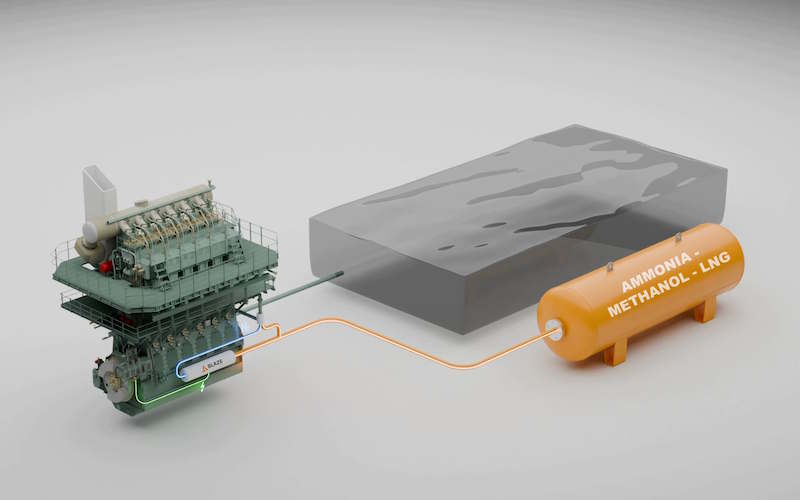
The first project under the MRCA is with Blaze Energy to pilot a next-generation, compact, engine-integrated fuel reformer designed to accelerate the practical adoption of alternative fuels in commercial shipping.
Rok Sitar, Blaze Energy CEO and Co-Founder, said: “The most important step toward commercial deployment for maritime hardware technology is moving from lab-proven to vessel-proven — demonstrating performance under real operating conditions at sea. We are excited to partner with ABS and lomarlabs, on a programme that addresses exactly this challenge. It gives Blaze Energy a structured, accelerated path toward pilot vessel deployment and, ultimately, full regulatory approval. Through our Flex-Fuel Reformer, vessel operators can gain fuel flexibility and stronger regulatory compliance, with complete confidence in its safety and performance.”
ABS new technology qualification (NTQ) services provide vendors and end-users with a clearly defined approach to confirm new technologies perform intended functions in accordance with defined performance requirements.
Image: Engine-integrated fuel reformer (credit: Blaze Energy)