
In-water ship cleaning is one of the fastest ways to cut fuel use, emissions and the spread of invasive species. But with a binding IMO biofouling convention on the way, experts at the recent Port Inspection & Cleaning Conference (PortPIC) warned that the industry must now prove what its cleaning systems and coatings deliver, with more transparency and verifiable performance.
Every ship carries cargo that never appears on the manifest. A film of slime on the flat bottom, barnacles near the waterline, weed in a sea chest: none of it is declared, but all of it shows up on the fuel bill. The conference experts warned that more transparency and verifiable performance are needed.
The International Maritime Organization (IMO) has put numbers on it. Its GloFouling study found that slime just 0.5 mm thick, covering half the hull, can raise a ship’s GHG emissions by 20 to 25%, and a light layer of barnacles or tubeworms by up to 55% on an average container ship. Fouling is also a major vector for invasive species.
The stakes are rising. Fuel can make up as much as 60% of a ship’s operating costs, depending on vessel type and trade. IMO’s 2023 GHG Strategy targets net-zero emissions by or around 2050, but the vote on the Net-Zero Framework meant to deliver it was postponed in October 2025, adding to owners’ uncertainty. Either way, shipping costs face upward pressure, and the bill ultimately lands with charterers and consumers.
Why clean hulls matter
To stay commercially afloat, operators must run leaner, cleaner ships, and controlling fouling on the hull and in niche areas is one of their biggest levers. Unchecked, the added friction can push fuel costs up by as much as 80%, and the penalty bites hardest at low to moderate speeds, where friction makes up more of total resistance. For an industry that has learned to slow down, that matters.
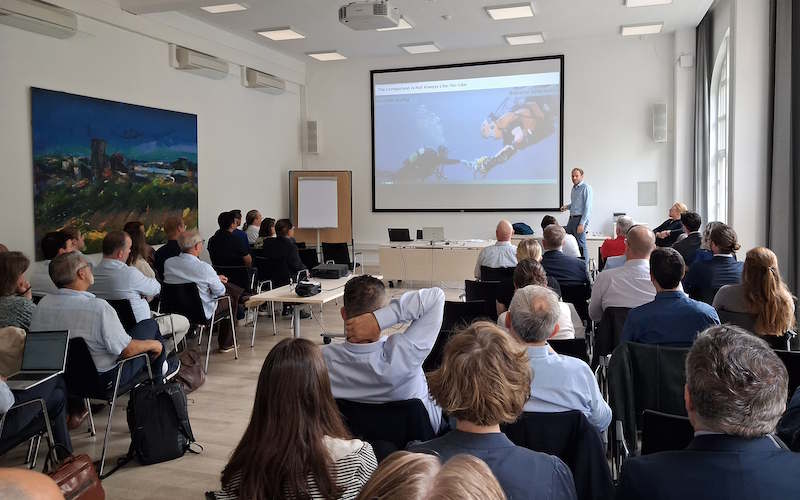
The seventh edition of PortPIC, held in Mülheim, Germany, on 16-17 September 2026, brought together more than 60 participants, including in-water cleaning companies, port authorities, coatings manufacturers, research institutes and ship operators and charterers such as DS Norden, MPC Container Ships, Shell, Carnival Maritime and Spliethoff, to discuss inspection and cleaning, standards, regulation and testing.
Opening the two-day conference, Volker Bertram of organiser VB Conferences, set out why the conversations at PortPIC matter now. “The IMO’s decision to make biofouling management mandatory, with a draft convention expected around 2029, is already reshaping the market as forward-looking owners and operators prepare,” he said. “PortPIC keeps participants informed and ahead, sharing best practice and talking openly about where the challenges lie.”
The recurring word in the PortPIC community: capturing. Collecting removed fouling and paint particles looks set to be fixed in future rules, but the details are open. How much must be captured, down to what particle size, measured by area or by weight, and how will it be verified? “The bad news: we don’t have the final answers yet. The good news: we are making progress with pilot projects on practical testing,” Bertram said.
ISO 6319: one rulebook for every port
Norway’s Bellona Foundation received this year’s Hull Management Hero award for its role in developing ISO 19030 for hull performance monitoring and ISO 6319 for in-water cleaning.
Bellona’s Irene Tvedten explained that ISO 6319, published in March 2026, deliberately avoids favouring any cleaning regime. Instead, it focuses on “standardising the planning, approval, execution and documentation of the in-water cleaning event itself”.
“It adds to IMO’s 2025 in-water cleaning guidance by setting out which information and how and when it should be evaluated in chronological order,” said Tvedten. Thresholds and performance criteria stay with local authorities, but owners and service providers get one documentation package they can take from port to port, and some ports are already looking at writing the standard into their rules.
Testing: the new bottleneck
“Testing has become the bottleneck in the adoption of in-water cleaning with capture,” said Karl Lander of Subsea Global Solutions. ISO 20679 sets out how to test a system but not what counts as a pass, and one country’s results rarely count in another. With IMO guidance recommending trials on at least three ships with different coatings, costs multiply with every jurisdiction. Even sampling can trip up: barnacle and mussel shells can be bigger than the sample ports.
Jørn-Erik Hausmann of the Port of Bergen, working with DNV, NIVA and the Norwegian Maritime Authority, combines ex-situ tank tests, which measure capture efficiency under controlled conditions, with in-situ tests on real ships. Their pilot proposes at least 80% capture and separation efficiency as a pragmatic benchmark, though niche areas and different coating types need more work.
Pernille Bohn of DHI argued that bench-scale, ex-situ and in-situ tests are needed together to catch surprises, such as a system that works well until it meets a particular coating. And Pascal Guth of DTU noted that cleaning simply starts the next fouling cycle: more aggressive cleaning may bring faster regrowth.
The question is no longer whether a hull can be cleaned, but whether the result can be proven in every port that asks, at a cost that leaves a viable business.
Finding the regulatory sweet spot
Making sure the coming convention rests on evidence is the aim of the Biofouling Research and Data Development (BRADD) project, which Lander and Jotun’s Petter Korslund updated delegates on. It is coordinated by industry association BEMA, championed by its members and draws on data from across the industry.
BRADD is working through seven questions: fouling prevention, the invasion risk from microfouling, cleaning without capture, achievable capture rates, coating compatibility, global cleaning capacity and compliance. The goal is a regulatory sweet spot where environmental risk, technical capability and cost overlap, with thresholds and timelines based on measured performance rather than negotiated without data.
Capacity is a live concern: require capture before enough capture-capable services exist, and ships could in effect be shut out of trade. Findings will feed into IMO’s PPR sub-committee through 2027.
Counting the full climate cost
Jotun’s Anders Skilbred asked whether proactive hull cleaning still pays off for the climate once the solution’s own footprint is counted. His paper examined Jotun’s HullSkater robotic cleaning combined with a compatible antifouling coating and performance monitoring to ISO 19030, backed by independent third-party verification of speed-loss and emissions claims.
Verified data showed no measurable speed loss over an average of 3.5 years, which for one large container ship meant an estimated 17,300 tonnes of CO2 avoided a year. The coating, robot and onboard station account for around 423 tonnes of CO2 equivalent at installation and about 2,036 tonnes over 25 years. Against estimated lifetime savings of 432,500 tonnes, the benefit outweighs the footprint by more than 200 to one. “Everything comes with a footprint,” as his summary slide put it, which is why transparent reporting matters.
Jotun’s Tanja Perander turned to sea chests, the recesses where seawater is drawn in for cooling. Sheltered from flow and hard to inspect or clean, they are hotspots for fouling and invasive species. Perander’s paper examined how controlled surface preparation and application can improve antifouling performance there. “Our research recommends assessing sea chests separately from the hull, since a clean grating is no proof of a clean interior” said Perander and added, “Ranking individual products will need further inspections, but our study gives a strong indication that controlled preparation and application of a suitable coating can reduce fouling in operational sea chests.”
Robots, vision AI and cleaning on the move
Robotics and AI ran through the conference programme. Michael Stein of Vesselity described how micro-ROVs and computer vision are moving hull management “toward condition-based strategies”, with frequent, repeatable inspections replacing the single snapshot at dry-dock. Atlantic Tech & Candy and Blue Atlas Robotics showed how inspection video can be turned into a hull roughness estimate and a fuel penalty.
Fraunhofer CML’s Lennart Grambow presented robots working in tandem, pairing an uncrewed surface vessel with a ROV that locates itself on the hull to within about one metre.
In-transit cleaning drew particular attention. Levi Gershon of CRABI Robotics presented autonomous, magnetically attached robots that groom the hull every 10 to 14 days while under way, sharply cutting the average fuel penalty compared with annual cleaning. Only time at sea, he argued, “can support that frequency, and only autonomously”.
The forum: money talks
PortPIC closed with its traditional forum, moderated by Bertram and Korslund, with panelists Karl Lander (Subsea Global Solutions), Mario Auran (Port of Bergen) and Thiago Pessoa (DS Norden).
Is in-transit cleaning a game changer? “If ship owners could have their hull cleaned every day at no cost, with no impact on schedule and no damage to the paint, why wouldn’t they do that?” asked Lander. Pessoa wants the benefits proven first, but sees a role when coatings stop protecting and ports refuse to allow cleaning. And on robots versus divers: “I’ll call it as a diving company: the robots are coming,” said Lander.
Awareness remains a hurdle. Pessoa said some commercial teams who buy, sell and charter ships do not know what an antifouling certificate is. “Everything we talk about needs to be translated into money, into the P&L of the commercial teams,” he said. Lander added that hull cleaning is often booked as maintenance, not decarbonisation, so the department paying for it never sees the fuel savings.
Auran said Bergen is one of very few ports to make capture mandatory, “but that doesn’t help if the ship can just go to the next port.” Regulation also creates a market, he argued, and Bergen rewards good environmental data, including recent hull cleaning, with harbour fee rebates.
Asked about speed limits, Bertram said IMO already pushes speeds down through EEDI and CII, since power rises roughly with the cube of speed, while pricing fuel and carbon is the strongest lever. One delegate added a biological caveat: slow below about 14 knots and fouling starts to settle.
For Bertram, the biggest block is the owner-charterer split, where “the other guy pays and the other guy benefits, so nothing happens.” His remedy is transparency: put a ship’s actual condition and predicted fuel consumption into the charter party, and charterers can choose the better ship, giving owners a reason to invest in the hull. Korslund said larger charterers are already approaching coating suppliers directly, driven by CII, EEXI and EU carbon costs.
Summing up the discussions at PortPIC, Korslund said, “The IMO’s biofouling convention is advancing, and port state enforcement is evolving. PortPIC’s open, collaborative spirit keeps participants informed and ahead. Also, our discussions are aligned with the IMO’s aim to turn policy into practice for the ship owners and operators who must navigate the regulations on their decarbonisation journey.”
The PortPIC 2026 proceedings are free to download here.
Image: Over 60 delegates drawn from global shipping gathered in Mülheim, Germany for PortPIC 2026, with the latest developments in inspection and cleaning, standards, regulation and testing all high on the agenda (source: PortPIC)