
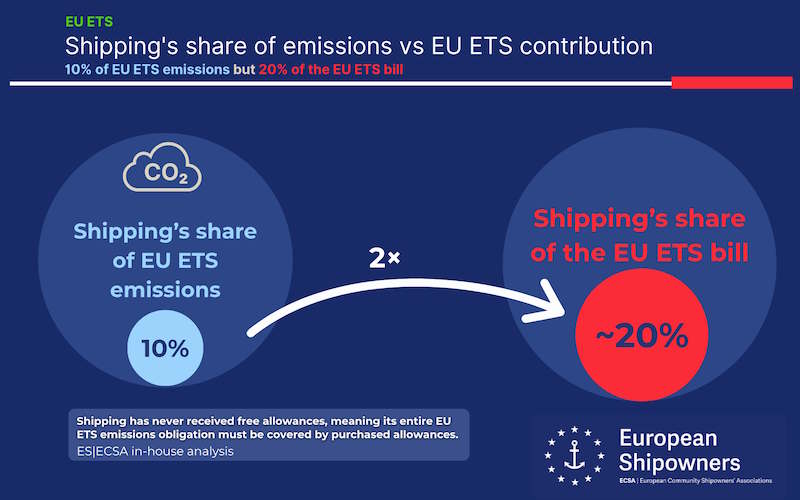
A new study by European Shipowners (ECSA) finds that shipping pays twice its share to EU ETS: ECSA believes that earmarked revenues should triple to help build market for sustainable fuels and technologies.
According to the study, shipping is responsible for around 10% of EU ETS emissions but pays almost 20% of the ETS bill. Unlike other sectors, it has never received free allowances. The new sustainable maritime alternative propulsion (SMAP) mechanism is a chance to reinvest part of this contribution in shipping’s energy transition. But the ECSA study finds that the Commission’s proposed 110m allowances cover only a third of what is needed.
ECSA says that SMAP needs at least 330m allowances (€30bn) to help create a market for sustainable maritime fuels and technologies. For SMAP to meet this objective, this support must cover all sustainable fuels and technologies, including energy efficiency projects, that facilitate the energy transition of shipping.
ECSA is calling on the European Parliament and the Council to at least triple the ETS revenues earmarked for SMAP. This is seen as crucial to helping shipping meet FuelEU Maritime’s 2040 target, while helping to create a market for sustainable fuels and technologies that facilitate the energy transition of shipping.
Sotiris Raptis, Secretary General, European Shipowners, said: “Shipping pays almost 20% of the total ETS revenues, although it is responsible for 10% of the emissions covered by the ETS. Unlike other sectors, it has never received a single free allowance. The new ETS mechanism that earmarks part of these revenues offers an opportunity to support shipping’s energy transition. However, the Commission proposal covers only a third of what is needed to help create a market for clean fuels and tech. The European Parliament and the Council must at least triple the earmarked ETS revenues in SMAP to provide a credible market signal for the scale-up of sustainable maritime fuels and technologies, including energy efficiency projects. SMAP can contribute to the energy transition of shipping, but only if it is sized to match the scale of the challenge and covers all technologies that deliver carbon savings.”