
The Ports of Shanghai and Melbourne have launched an implementation plan for the Shanghai–Melbourne green shipping corridor (GSC) to respond to the urgent need to decarbonise maritime shipping.
Established during the North Bund Forum in Shanghai in October 2025, this new corridor has now moved into its delivery phase, turning a shared vision into concrete actions for the two ports and industry partners. The plan is being facilitated by C40 Cities, a grouping of the leaders of major world cities formed to confront the climate change and employ a science-based approach to limiting global warming.
The GSC implementation plan lays out clear steps to advance the use of green methanol and other non-fossil-based low-carbon fuels as cleaner alternatives for powering ships. The Port of Shanghai, the world’s busiest container port, has set an ambitious goal to reach an annual bunkering capacity of 1m tonnes for green methanol and biofuels. The Port of Melbourne, Australia’s largest container port, has committed to net zero by 2030 for its own business operations and aims to progress bunkering feasibility in Melbourne through the plan.
To achieve these goals, the plan includes a vision and actions towards:
- Completing a baseline and feasibility study and deploying one or more low-carbon fuel container vessels on the Shanghai-Melbourne Route by 2035.
- Sending a clear demand signal to shipping lines, fuel suppliers and policymakers that the Shanghai-Melbourne trade lane is a priority route for low and zero carbon shipping investment.
- Working closely with shipping lines and energy suppliers to accelerate the adoption, production, transportation and supply of low carbon fuels, leveraging Shanghai’s existing methanol bunkering capacity and progressing the feasibility of bunkering in Melbourne.
- Advancing shore power through feasibility assessment and supporting enabling infrastructure at the Port of Melbourne.
- Advancing digitalisation and innovation to support corridor decarbonisation and supply chain efficiency, including exploring port-to-port and ship-to-port data connectivity, voyage optimisation and interoperable digital systems to improve transparency, operational efficiency and emissions performance across the corridor.
- Exploring opportunities to improve efficiency, cost control and integrated supply chain capability while establishing a credible and scalable model for cross-border port collaboration that can support and be replicated across other Australia–Asia trade routes.
The shipping corridor will demonstrate that when ports in different countries work together, a more efficient model can be created that other ports and shipping routes can learn from and replicate.
The Port of Shanghai, through the Shanghai Municipal Transportation Commission, the Port of Melbourne and C40 Cities, joined efforts in this green shipping corridor partnership alongside industry partners such as Shanghai International Port Group (SIPG) and Cosco Shipping Lines. The efforts include collaboration with energy providers like HAMR Energy, Abel Energy, and Shenergy to support fuel production and supply, following the China Classification Society (CCS)’s leadership on fuel standards and certification.
C40 Cities supports the green shipping corridor initiative by convening, facilitating, coordinating, and communicating activities between stakeholders. C40 acts in a facilitation role alongside the founding partners, the Port of Melbourne and Shanghai Municipal Transportation Commission, to help drive the initiative. The launch of the GSC implementation plan aligns with the 20-year anniversary of the Shanghai–Melbourne sister-port partnership. China is Melbourne’s largest trading partner, responsible for 50% of container imports and 20% of exports.
Kevin Austin, Deputy Executive Director, C40 Cities, said: “Accelerating efforts to decarbonise the shipping sector is urgent if we are to limit global heating in line with the Paris Agreement. The green shipping corridor implementation plan responds to that urgency with a clear and phased pathway. It shows how international collaboration can deliver real progress with non-fossil-based low-carbon vessels, cleaner port operations, and a model other trade routes can replicate.”
Saul Cannon, Port of Melbourne CEO, added: “We are committed to net zero emissions for our own operations and we’re equally focused on supporting decarbonisation across the supply chain. The Melbourne-Shanghai implementation plan puts those commitments into practice, advancing shore power potential, progressing green fuel bunkering feasibility, and seeking to deploy non-fossil-based low-carbon vessels on the route.”
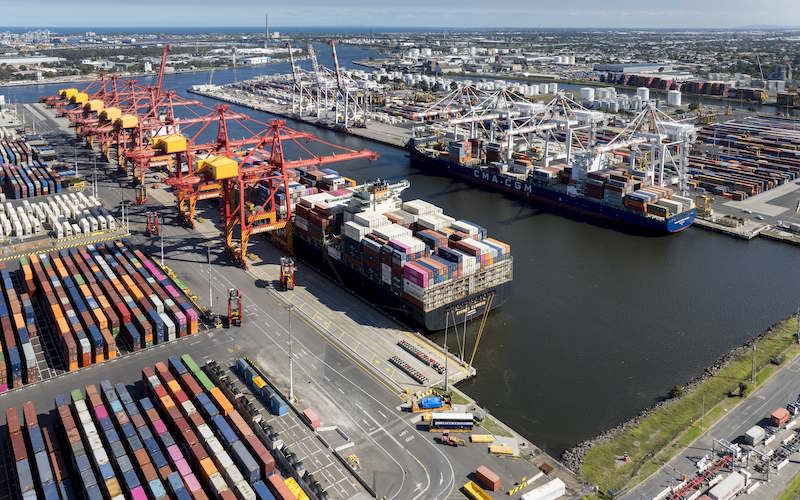
Image: The Port of Melbourne is joining with Shanghai to promote a green shipping corridor (credit: Port of Melbourne)