
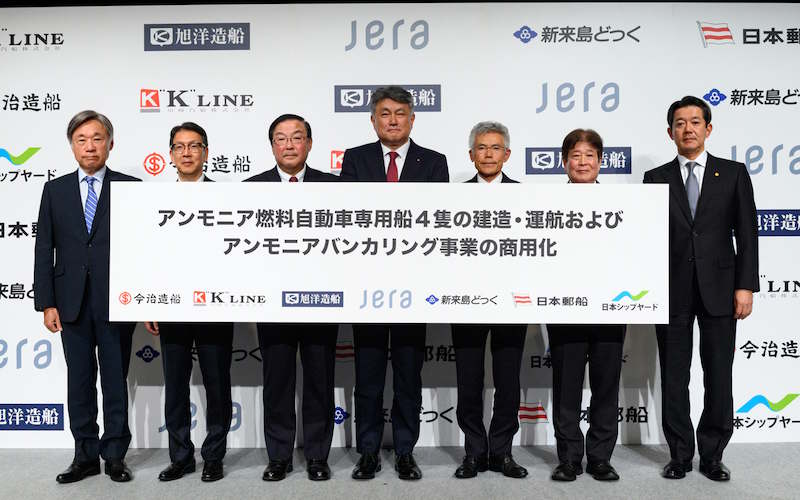
Imabari Shipbuilding, Kawasaki Kisen Kaisha (‘K’ Line), Kyokuyo Shipyard, JERA, Shin Kurushima Dockyard, Nippon Yusen Kabushiki Kaisha (NYK), and Nihon Shipyard (NSY), have agreed to develop an ammonia fuel supply chain in Japan’s Chubu region and to build and operate four ammonia-fuelled car carriers supported by the supply chain.
The project is seen as a comprehensive initiative to develop an integrated ammonia fuel supply chain, from the procurement of green ammonia and development of ship loading facilities to the construction of a dedicated bunkering vessel with fuel supply through ship-to-ship (STS) bunkering, and the operation of ammonia-fuelled car carriers.
To address the need to reduce GHG emissions from international shipping as well as customers’ Scope 3 emissions, the seven companies aim to establish a stable ammonia fuel supply system through the integrated development of the supply chain. This project is expected to result in the world’s first commercial supply chain, with the Chubu region serving as the hub, integrating fuel procurement, supply infrastructure at the Hekinan terminal, and vessel operations.
Ammonia is considered a next generation fuel that emits no CO₂ when combusted and can be stored and transported in liquid form. In particular, steady progress is being made toward the practical use of low-carbon ammonia, which is produced with reduced CO₂ emissions during the manufacturing process. In the future, its use is expected to expand into maritime applications and other industries.
By combining their respective technologies, expertise, and infrastructure, the seven companies intend to establish an advanced integrated business model that brings together ammonia fuel procurement and supply, the construction of ammonia-fuelled car carriers, and development of an ammonia bunkering vessel. Through this initiative, the companies will promote the decarbonisation of international shipping through a Japanese industry collaboration while also supporting the broader use of ammonia for industrial and other applications. In doing so, they aim to contribute to the realisation of a sustainable society and the development of a low-carbon ammonia market.
JERA is advancing the development of a lower-carbon ammonia value chain as part of its efforts to achieving net-zero CO₂ emissions from its domestic and overseas businesses by 2050, and contribute to global decarbonisation and address the world’s energy issues. Its initiatives include the use of lower-carbon ammonia at the Hekinan Thermal Power Station for fuel substitution to decarbonise the thermal power generation business, and the installation of tank truck loading facilities to supply lower-carbon ammonia to other businesses. JERA will procure green ammonia produced using renewable energy. These supplies are intended to come from regions including India. In addition, JERA will develop new ship loading facilities at the ammonia receiving terminal adjacent to the Hekinan Thermal Power Station, which will establish a stable supply system for the bunkering vessel. JERA will contribute significantly to the decarbonisation of international shipping and to Japan’s decarbonization efforts, with the Chubu region serving as a key hub.
Kyokuyo Shipyard, which possesses capabilities in building specialised vessels, will build the ammonia bunkering vessel. It is scheduled for completion in 2030, the same as the ammonia-fuelled car carriers. Following completion, the vessel will be owned and operated by NYK or a wholly owned NYK subsidiary.
‘K’ Line and NYK will establish a fuel sales joint venture, equally owned by the two companies, to facilitate fuel sales and supply between vessels. Using a bunkering vessel owned and operated by NYK or a wholly owned NYK subsidiary, the joint venture will supply ammonia fuel to car carriers through STS bunkering. By combining stringent safety standards and operational experience the two companies have accumulated in handling ammonia and LNG, they aim to establish a safe, efficient fuel supply system.
‘K’ Line and NYK are working to transition to next-generation fuels to achieve net-zero emissions by 2050 and provide cleaner transportation services that meet society’s growing need for low-carbon and decarbonized solutions. Under this project, each company will introduce two ammonia-fuelled car carriers, a total of four vessels. Following their scheduled completion in 2030, the vessels are expected to transport finished vehicles for customers including Toyota Motor Corporation. The vessels will be Japan’s first ammonia-fuelled car carriers. They will be equipped with dual-fuel engines capable of using ammonia as fuel, as well as fuel tanks with sufficient capacity to enable trans-Pacific voyages using ammonia fuel alone. To ensure the safe use of ammonia, which is toxic and corrosive, the vessels will also incorporate a multi-layered safety concept, including measures to prevent and detect leaks and to neutralise ammonia in the event of a leak.
Drawing on its track record in building car carriers, Shin Kurushima Dockyard will lead the basic design phase. The vessels will then be jointly designed and built by Shin Kurushima Dockyard, Imabari Shipbuilding, and NSY — each bringing experience in car-carrier construction. By bringing together their advanced technological and shipbuilding capabilities, these three companies aim to realise next-generation vessels that combine high safety in open-sea operations with environmental performance.
Image: The seven companies have formed a collaborative project (source: K-Line)