
Inspection, certification and consulting group RINA, with shipbuilder Fincantieri and energy company Eni have released the second edition of the ‘Sustainable Maritime Transport Outlook’, developed with the technical support of Bain & Co Italy.
The outlook provides a global overview of solutions for decarbonising maritime transport, comparing different technology and fuel options in terms of their emissions reduction potential, maturity, infrastructure availability and the evolution of their total cost of ownership through to 2050. The quantitative analysis is supported by a broad range of interviews with operators and stakeholders across the value chain, including shipowners and operators representing around 40% of the container market and 20% of the cruise market, engine and propulsion technology suppliers accounting for more than 80% of the ICE market, as well as ports and industry associations. Together, these interviews provide a clear picture of market realities.
The key message emerging from this second edition is that the landscape is more uncertain than it was a year ago. However, competitive solutions are already available to reduce environmental impact today, offering a pragmatic response to the European regulations currently in force while the industry awaits global decisions from the IMO.
Under the outlook’s reference scenario, ‘Today as Future’, Europe is expected to achieve an 80% reduction in emissions intensity by 2050 compared with 2020 levels, while the reduction globally is projected at around 40%. The outlook considers a slower scenario, ‘Decarbonisation by 2070’, under which the achievement of Europe’s decarbonisation targets is postponed until 2070, with countries in the rest of the world following several years later.
Compared with 2025, three of the four indicators shaping the transition, namely the regulatory framework, macroeconomic conditions, fuel and infrastructure availability, and technological maturity, have deteriorated, with regulatory uncertainty having the greatest impact. The global IMO agreement has been postponed and, when countries are weighted by tonnage, almost 90% support a more gradual pathway, while the US has taken a position against maritime decarbonisation. Europe, by contrast, has reaffirmed the targets already established under FuelEU Maritime.
The economic outlook has become more uncertain due to slowing growth, tariffs and geopolitical tensions, while the crisis in the Strait of Hormuz is increasing risks to trade flows and the global economy. The low-emission hydrogen value chain has lost momentum, with various maritime projects put on hold. Technology nevertheless continues to play an enabling role, with the orderbook for alternative-fuel vessels growing slowly but steadily. However, against a backdrop of uncertainty, shipowners are increasingly favouring mature, readily available solutions.
Synthetic fuels produced from green hydrogen will be essential to complete the pathway to net zero, but they remain expensive and depend on a supply chain that has yet to be fully developed.
Through Enilive, Eni is among the leaders in the production of HVO biofuels from renewable feedstocks. These fuels are not only seen as a solution for contributing to decarbonisation, but also an important component of industrial strategy and a means of strengthening the resilience of the production system. Alongside LNG and bio-LNG, biofuels can support maritime transport decarbonisation by leveraging already existing vessels and infrastructure. However, to fully unlock their potential and help the maritime sector progress towards climate neutrality, a regulatory framework is needed that recognises their role across all transport sectors, together with pragmatic and stable operational rules that can support investment development.
Fincantieri says it supports shipowners on their decarbonisation journey through a pragmatic and flexible approach, integrating different technologies and developing innovative solutions. In the cruise sector, LNG is currently the leading alternative fuel, paving the way for progressive decarbonisation through bio-LNG and, in the longer term, e-LNG. Biofuels such as HVO and dual-fuel propulsion systems further broaden the range of available options. At the same time, the Fincantieri group is working to improve the efficiency of the ship as an integrated system and is developing new energy and propulsion solutions, while exploring longer-term opportunities through research into nuclear technologies.
RINA contributes to the decarbonisation of maritime transport by providing operators across the value chain with its engineering and technological experience, supporting them in identifying and adopting effective solutions. In particular, the RINA group assesses the technological maturity, practical feasibility and environmental performance of different alternatives, while helping to verify their compliance with regulatory requirements.
The outlook aims to set out concrete commitments for every player across the value chain: common rules and standards for regulators and certification bodies; targeted investment and flexible infrastructure for ports; availability and diversification for fuel suppliers; vessels designed to accommodate multiple solutions and retrofit support for shipyards and shipowners; and continued investment in research and development by engine manufacturers. Pragmatism does not mean waiting: it means starting with mature technologies while building platforms that can evolve over time.
Against the backdrop of an increasingly complex geopolitical environment, Eni, Fincantieri and RINA have formalised their commitment to continue this work for the next three years.
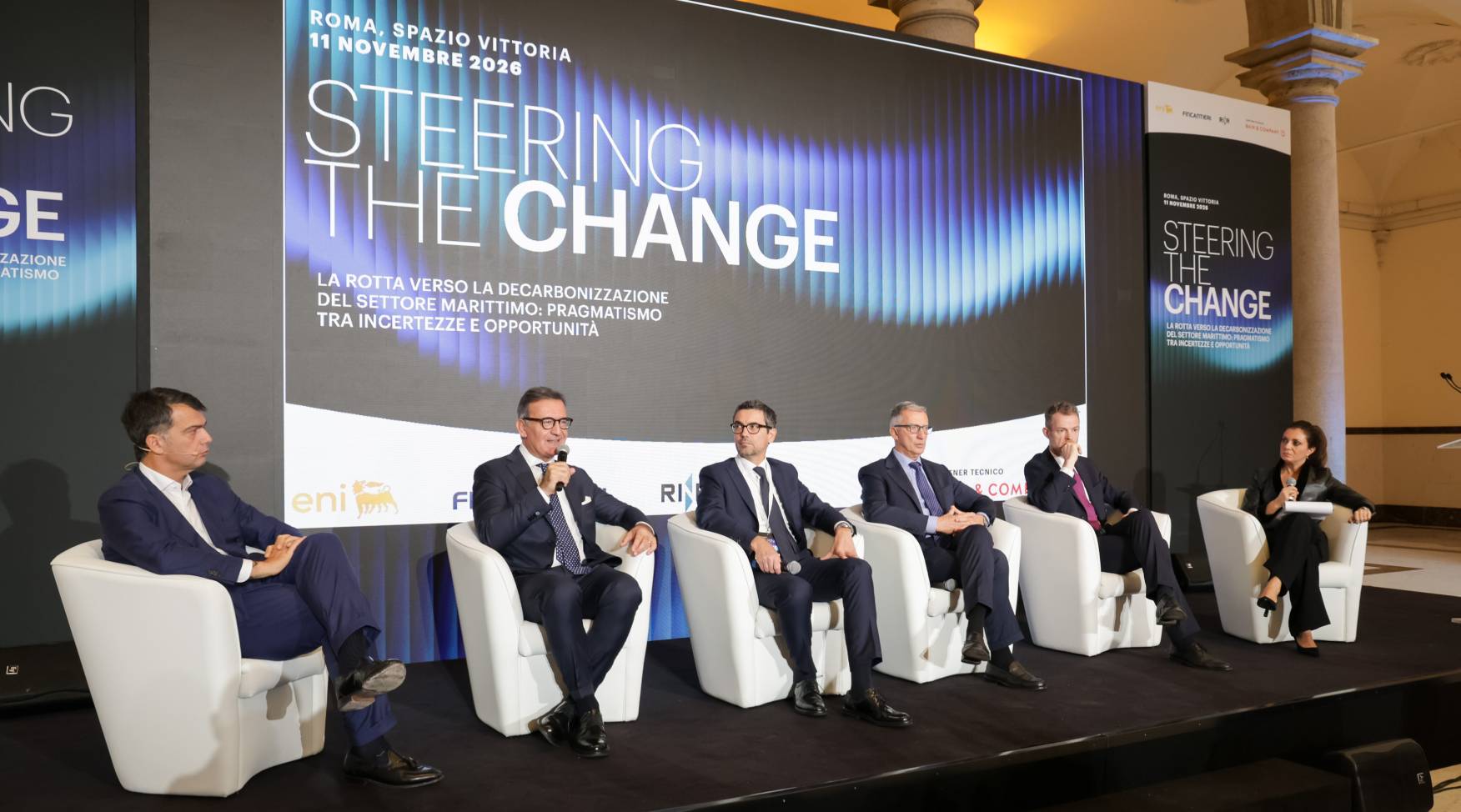
Image: (From left) Pierluigi Serlenga – Bain & Company; Paolo Moretti – RINA; Stefano Ballista, Giuseppe Ricci – Eni; Claudio Cisilino – Fincantieri; and Tonia Cartolano – Sky TG24 (source: RINA)