
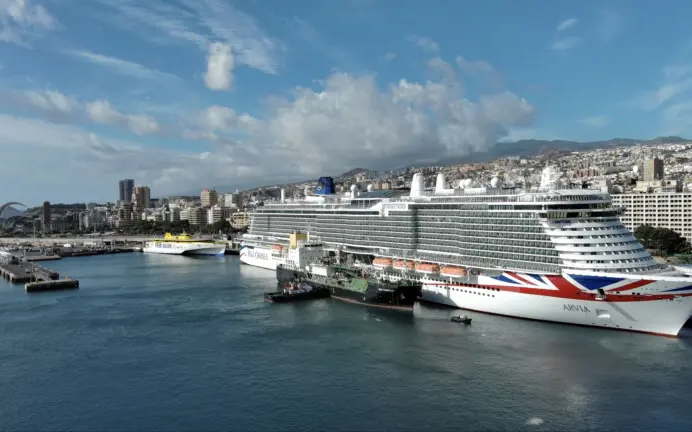
The Port Authority of Santa Cruz de Tenerife has joined the Sea-LNG coalition, extending Sea=-LNG’s reach along major shipping routes linking Europe, Africa and the Americas.
The port authority, which manages six ports across the Canary Islands, is Sea-LNG’s first member based in the Mid-Atlantic. Tenerife has established itself as an LNG bunkering hub in the Mid-Atlantic since 2019, when the Port of Santa Cruz de Tenerife became the first port worldwide to host a ship-to-ship (STS) LNG bunkering operation for a cruise ship. Since September 2026, the port has been supplying LNG to Baleària vessels through regular truck-to-ship bunkering operations. More than 30 LNG bunkering calls are already scheduled for the 2026/2027 cruise season, reflecting the port’s importance as a strategic refuelling location for LNG-fuelled vessels operating in the Atlantic. The port authority’s ports, particularly the Port of Granadilla, offer opportunities to develop LNG infrastructure, bunkering and storage, further strengthening Tenerife’s role in global maritime decarbonisation.
The port authority’s membership comes as the methane pathway continues to enable the cruise sector’s energy transition. LNG is seen as a clear favourite for cruise ships, bringing immediate local air quality benefits, virtually eliminating SOx and particulate matter and significantly reducing NOx, while also cutting GHG emissions today. The same bunkering infrastructure can then supply liquefied biomethane (LBM/bio-LNG), which reduces GHG emissions by up to 80% compared with marine diesel on a full well-to-wake basis, with some cruise operators already running their vessels on LBM today.
Airam Díaz Pastor, Deputy Director, Port Authority of Santa Cruz de Tenerife, said: “The Ports of Tenerife have become a leading LNG bunkering hub in the Mid-Atlantic, and demand from LNG-powered vessels operating in the Atlantic continues to grow. We recognise LNG as a fuel in transition for the maritime industry, with liquefied natural gas delivering immediate benefits for local air emissions while providing a pathway towards adopting renewable and lower-carbon fuels such as liquefied biomethane. Joining Sea-LNG is an important opportunity to strengthen our collaboration with the international maritime industry and support the development of cleaner marine energy solutions.”
Steve Esau, Sea-LNG COO, added: “The Port Authority of Santa Cruz de Tenerife is a great addition to the Sea-LNG coalition. This extends Sea-LNG’s membership into the Atlantic and brings us closer to a long-time advocate for LNG as a marine fuel. For destinations that depend on tourism, removing local air pollution matters just as much as reducing greenhouse gas emissions, and LNG delivers both today. As part of the methane decarbonisation pathway, the infrastructure being developed in Tenerife can go on to supply bio-LNG and e-methane, supporting the industry’s journey to net zero.”
The Port Authority of Santa Cruz de Tenerife brings a strategic perspective to the coalition, given its location on Atlantic shipping routes, and strengthens the network of LNG bunkering locations available to the global LNG-fuelled fleet. LNG bunkers are now available in 222 ports worldwide, with plans underway for a further 62, and LNG dual-fuel vessels account for around 90% of the alternative-fuel orderbook.
Image: Port of Santa Cruz de Tenerife (source: Sea-LNG)