
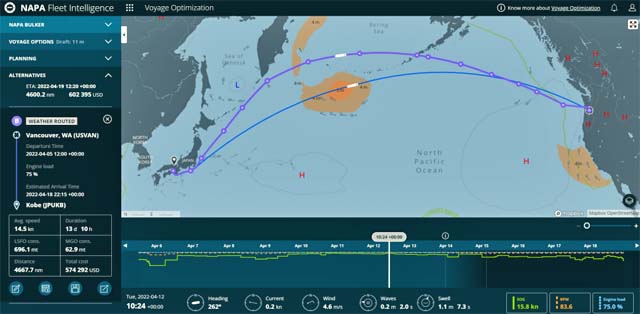
Maritime software, services, and data analysis provider Napa is to work with class society ClassNK and Japanese general trading company Marubeni to assess what fuel and carbon emission savings can be achieved through voyage optimisation.
Napa will use its Fleet Intelligence platform to retrospectively analyse the impact of EEXI using the actual vessel performance across Marubeni’s fleet and compare it against similar fleets. ClassNK will provide verification, analysis and accuracy. Based on this, Napa will predict how well the Marubeni vessels will be able to perform in the future with reduced propulsion power and remain competitive in the market from 2023 onwards when new EEXI and CII requirements enter into force.
The cloud-based Napa Fleet Intelligence platform combines Napa’s experience in naval architecture with many years of data on actual sailed voyages and weather conditions, using the Napa performance model to generate insights. With no need for commissioning or hardware installation onboard vessels, the platform can analyse past performance and optimise fleet operations.
This will enable Napa, ClassNK and Marubeni to analyse the effect of EEXI requirements on Marubeni’s fleet in terms of transportation capacity, CO2 emissions and fuel consumption. Napa will calculate CII for vessels using historical operation data and predict how much performance can be improved with the company’s weather routing system, Napa Voyage Optimization.
Naoki Mizutani, MD Napa Japan, said: “Reducing emissions is a strategic priority for fleets around the world, and with so many options on the table, it makes sense to start by finding out what is achievable by just optimising voyages, without the immediate need for any new fuels or technology. As future fuels are likely to be expensive, fleets should be looking at how they can reduce fuel use in the first instance by operating more efficiently. However, given the multiple commercial incentives at play, this is no easy task, not to mention factoring in weather and ship-specific requirements. Investing in rigorous analysis at the outset will help Marubeni chart their course through the huge number of decisions that will be required to reduce emissions and remain competitive in the long term.”
Takayuki Hase, GM Ship Department, Marubeni, said: “It is a very exciting opportunity for Marubeni to collaborate with Napa and ClassNK on this joint study that will help reduce CO2 emissions and fuel consumption. We hope that this joint study will make a contribution to improving the maritime industry’s carbon footprint through digital solutions for shipping operations.”
Yoshimichi Sasaki, GM Digital Transformation Center, ClassNK, said: “Given that actual vessel performance will play a more pivotal role in shipping operations, ClassNK is very glad to be involved in this project. I hope that the initiative among three parties will be able to propose a model to utilise the actual vessel performance and extend its implementation in the maritime industry, leading to a low carbon world.”