
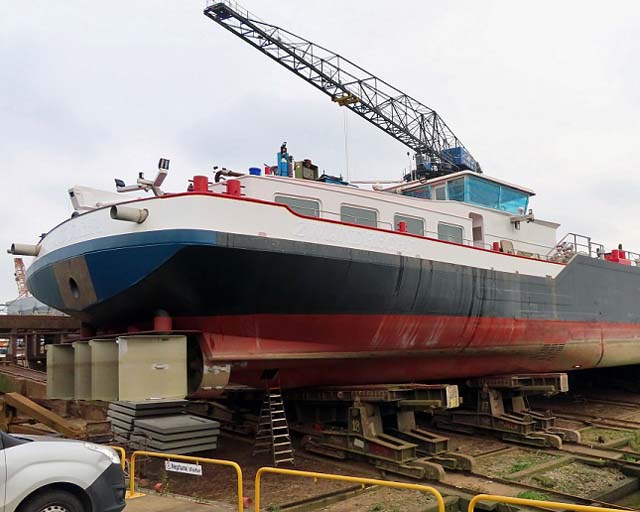
Universe Shipping’s two new inland tankers, ‘Moorea’ and ‘Messina’ are due to enter service in early 2022, equipped with the retractable Van der Velden RMS 2000 V active rotor manoeuvring system from Damen Marine Components.
The tankers have been bult to a shallow water design by RensenDriessen Shipbuilding, and are intended to navigate more safely, more economically and more environmentally friendly.
The Moorea and the Messina, each 135m long and 11.45m wide, both have a lightweight shallow-water hull (MoneyMaker 3.0 type) developed by RensenDriessen Shipbuilding.
Universe Shipping fleet manager Marc Stok said: “I knew the rotors from back in the day, I’d seen them on large ships before. That’s why I started looking into it again and as it turned out, DMC, with whom we’ve been working together for a long time, is still selling them.”
Leo van Zon, DMC Area Sales Manager said: “The rotors were popular in inland shipping from roughly the late 1980s to the late 1990s, after which they remained dormant for a long time. There are still captains who use them and now, the rotors are suddenly re-emerging because more and more ships are being designed for sailing at shallow water. If you have a shallow water ship design and the vessel is in an empty state and a crosswind picks up, it becomes a kind of sailboat, so to speak. You therefore have to ensure the course stability of the ship and you achieve that with the help of an active rotor system.”
DMC’s rotor manoeuvring system is based on the principle of the Magnus effect. By placing a rapidly rotating cylinder in approaching water, the resulting pressure difference creates a lifting force. This lifting force, or lateral thrust, is greater than with conventional rotors and ensures that the bow is much more manoeuvrable. Due to the increasingly important energy transition, this technique is now being used again. Designations such as Flettner Rotor, Magnus effect and all other forms of rotating poles to aid propulsion are widely used.
The RMS 2000 V-rotors (the designation V stands for Vertical) can be extended vertically and ensures that Universe Shipping’s new tankers can be safer, more economical and therefore also environmentally friendly.
Stok said: “Safer, because it allows you to keep the ship more stable, especially when empty when the wind is blowing hard. This system is a good example of how you can still steer while sailing. An active rotor, but in the smaller version. And environmentally friendly, because the rotors allow you to save fuel. With the rudder at the back, less steering is needed, so you don’t slow down the propulsion of the ship with every steering movement. You don’t have to worry about that with this system.”
The Moorea and Messina are currently being completed at Dolderman in Dordrecht, after the hulls have been built in China and Russia respectively. Both tankers will be navigating the Rhine and will be equipped as double propellers with two smaller screws and four matching rudders, so they can still be used at low water levels.
“Less rudder effect at low speed because the rudders flow is less, certainly in comparison with a larger propeller and suitable two-rudder system, while you still have to keep a ship of the same size on course. Hence Universe’s choice for the rotors,” said van Zon.
The majority of Universe Shipping’s inland tankers are equipped with DMC’s Van der Velden rudder and steering systems.
“Damen Marine Components is a trusted partner for us that we can rely on. We’re very satisfied with the collaboration. The lines are short and contact is good, we can always contact them for feedback and advice, they always reply to your question. That creates a very good bond of trust,” said Stok.